Pain. Chronic. Dull, aching, endless.
Warm saltwater exercise pool. A buoyant heaven. A respite, a chance to move without pain.
A “Fuck You!” to pain.
I wish the world would flood itself in a warm, smooth, as silk, upliftingly supportive matrix so that I could move about all day in such fashion.
This year, my one remaining hamstring has given way while walking down the steps. Gravity took its opportunity. My wife and friends once again raised me up.
This time, from the stones of the patio in the first thunderstorm of the year.
The Quads complain that the Hamstrings have left the building.
The Glutes are a pain in the ass and harangue me if I even think about stooping.
My Calf — the left, that bastard — cramps each night. Not the kind where you flex your toes and it meekly retreats. No. The Calf, that jerk, seizes the nightly opportunity to grab hold with gusto and refuses to let go of itself. Holding firmly, letting me know in no uncertain terms it feels overtaxed — or simply feeling so left out of the whole daily complaint that it can no longer stay quiet.
Last night, there was a super cramp in the Biceps Femoris. Oh, the knot. The pain. Then this morning, the acute complaints and complications of tearing tissues in slow motion.
The reminders that something is wrong are constant and chronic. Then the pronouncement of failures is acute.
You shall not walk upon me. Don’t you hear what I am saying? We hurt. We protest.
I find the ice pack and muster the strength to ignore something that will not remain silent, and limp through yet another day.
That’s the part that doesn’t translate into paragraphs.
Here’s the part that does.
Two kinds of pain walk into a bar.
Acute pain orders something strong, makes a scene, and leaves.
Chronic pain pulls up a stool, doesn’t order anything, and just… stays. It rearranges the furniture while you’re sleeping. It shows up in the middle of a sentence. It texts you at 3 AM to remind you it still exists, as if you could have forgotten.
Most people understand acute pain. It’s honest about what it wants: protect the injury, limit the damage, force rest. It has urgency and clarity and — if you’re lucky — an end.
Chronic pain is different. It’s not the same message repeated. It’s a new system. It’s the nervous system learning a habit — and like most habits, it doesn’t care whether it’s helpful.
There’s a distinction I keep coming back to, because the science teacher in me won’t leave it alone: hurt versus harm.
Harm is tissue damage — something tearing, breaking, degrading. Hurt is the nervous system complaining. In acute injury, they align. You’re hurt because you’re harmed. In chronic pain, they diverge. You can hurt without fresh harm. The signal stops matching the reality.
The brain and spinal cord start amplifying. They start scanning for threats the way a nervous security guard scans a parking lot at 2 AM — alert to everything, accurate about nothing.
And I get both. The acute flare — sharp, specific, immediate. And the chronic overlay — the background hum, the constant surveillance, the nervous system that won’t stand down.
Some days it feels like my body is running two operating systems at once, and both of them are arguing about which one gets to crash first.
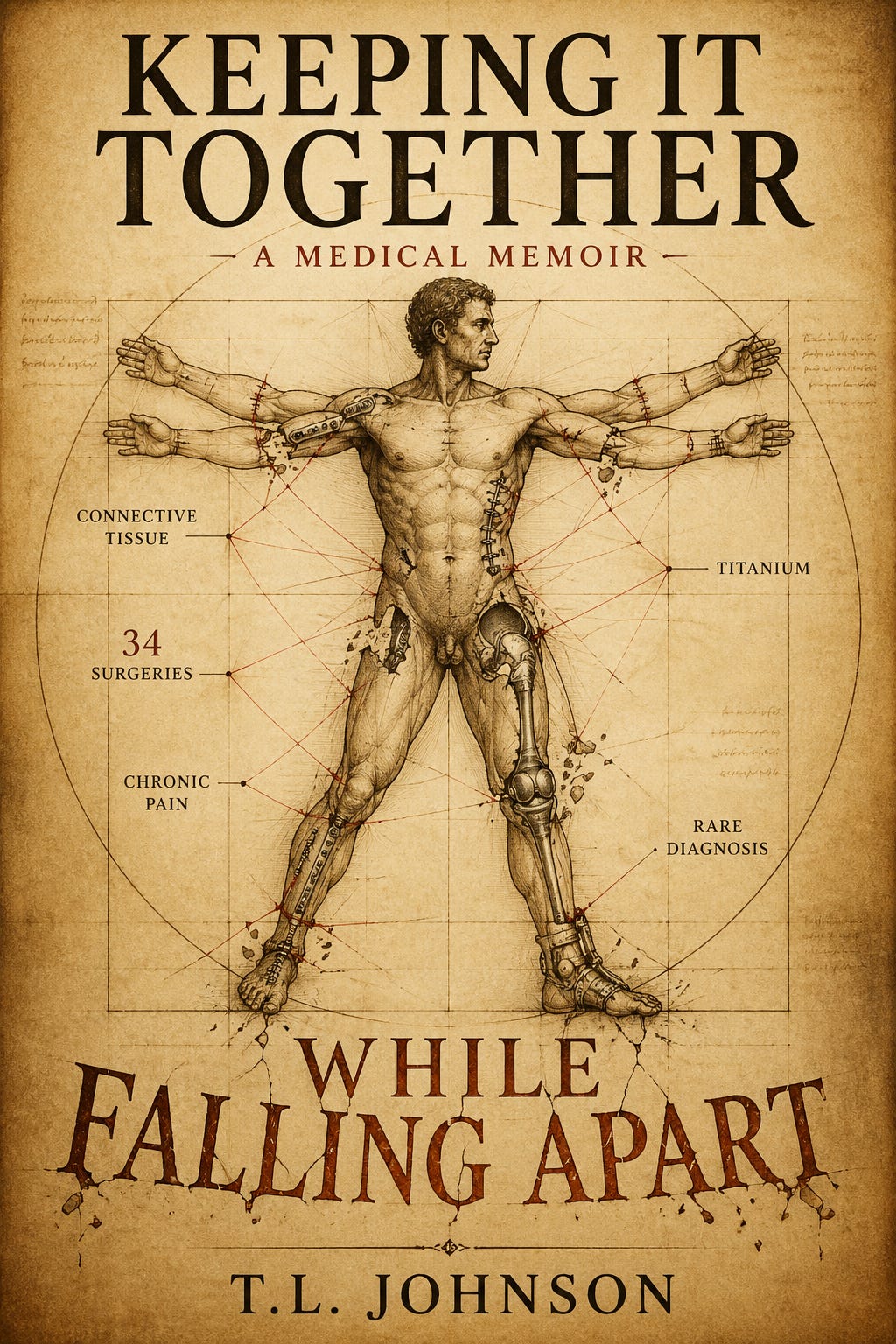
I am still writing.
I have had friends ask me, “Are you alright?”
The worried kind of asking.
The answer is hanging there in words I can’t quite manage. “It’s complicated.” Is the best I can do. I am keeping it together while falling apart.
Keeping It Together While Falling Apart — the memoir — is close to complete. Somewhere around 90,000 words now. It’s a medical mystery, a science education, and a personal reckoning, roughly in that order. It covers thirty-four surgeries, a rare genetic diagnosis I didn’t receive until I was sixty-one, a thirty-year teaching career I gave everything to, and the long, strange work of figuring out how to live inside a body that keeps rewriting the contract.
Writing it has been — I’ll be honest — its own form of pain rehabilitation.
Not metaphorically. I mean that the act of documenting what happened, naming it, putting it in order, has been part of how I’ve processed it. I write when I can, sometimes, one-handed. I write when I can.
The manuscript is there. It exists. And I intend to get it into readers’ hands.
This summer, I’m going to Rochester.
The Mayo Clinic Pain Rehabilitation Program sits out there on the horizon like a strange kind of pilgrimage. Not to fix the underlying disease. Not to replace what’s been torn. Not to promise me the body I used to have.
To teach me something, I am apparently not naturally good at learning. Maybe no one is.
How to live inside this body. The one that is falling apart.
When I first heard “pain rehabilitation,” my brain tried to translate it into something familiar. Physical therapy? Strength training? Rebuilding?
Yes and no.
From what I understand, it’s less about chasing pain relief like it’s a finish line, and more about retraining a system that has, over decades, learned the wrong things. It’s about function. About pacing. About teaching the nervous system that movement isn’t automatically catastrophe — even when pain shows up to argue otherwise.
Hopeful and infuriating in equal measure.
Hopeful, because it suggests I’m not sentenced to this forever.
Infuriating, because it means pain isn’t only happening to me — it’s happening through me. Through circuitry that adapted without my permission.
But that’s also the story, isn’t it? That’s the chapter I haven’t written yet.
Something is coming.
This summer, I’ll be launching a GoFundMe to fund professional editing, formatting, and cover art for the memoir.
Getting a book like this — one that asks something of its readers, that blends science and memoir and thirty years of hard-won frustration and a rare genetic diagnosis most people have never heard of — to the point where it’s truly ready is not a solo act. Good editing is expensive. It’s also non-negotiable if the book is going to do what I need it to do.
I’ll share more details when the campaign launches. For now: if this thread has meant something to you, if you’ve followed this story and wondered where it was going — that’s where it’s going. Toward publication. Toward something I can hand someone and say, here, this is what it was.
I’ll keep you posted.
In the meantime, I’m still here.
Still writing.
Still falling apart and still keeping it together.
— T.L. Johnson

