Chapter 5: Lonely Sovereigns
After his latest clients had flown the coop—peach parasol, lace, and indignation all flapping at once—Maurice busied himself with cleaning.
A new appointment was due in less than an hour, and the relentless blowing sand had once again begun its invasion of the interior. It found corners with the devotion of a pilgrim. It also frayed Maurice’s nerves.
He felt the need to be in motion.
To be doing something.
Something other than thinking.
Something itched at the back of his brain—a restless flutter that made stillness unbearable, like an itch you couldn’t scratch because it lived somewhere behind your thoughts.
Kodao paced along the counter. Back and forth. Back and forth. It tittered and whistled, as though practicing innocence.
“What are you up to?” Maurice asked.
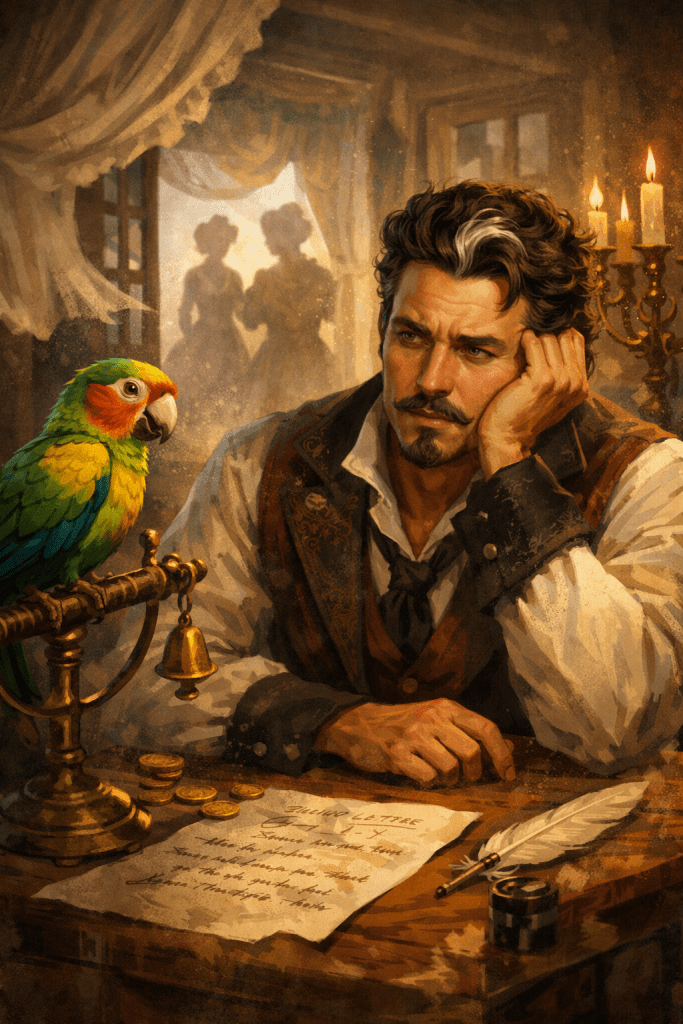
Kodao chirped with a nondescript reply.
“You know how this works,” Maurice said, lowering his voice as if the walls might gossip. “You stay stoic—silent—uninterested. Until we find a match for our client.”
Kodao made a sound suggesting I have always been stoic, and also that you are a liar who sells tea for gold.
“You are a lovebird,” Maurice continued, as patiently as a man explaining gravity to a cat, “not a participant or a commentator. You’re the silent partner.”
The bird chirped and chittered.
“Well—no,” Maurice amended. “Not silent. Still.”
Kodao tilted its head and issued a squawk that explained everything in plain parrot.
And while Maurice had known the bird since it was a hatchling, he still couldn’t interpret every syllable it threw at him. His own mind felt oddly unmoored—concentration difficult, focus blurry and abstract—like trying to read a love letter whose ink, intention, and prose had been smeared by some unnamed moisture, and Maurice could not tell whether it came from rain or tears.
Kodao, too, seemed perplexed—tuned perfectly to the emotions of humans it could sense, yet confounded by humans’ insistence on complicating what their hearts already knew.
After all, the bird was a conduit to love. Sensing when one soul was meant for another. Kodao was born for the purpose—attuned to the frequency, synchronized to the strum of heartstrings.
Maurice was a charlatan.
He had stumbled upon the parrot on the island of Oyster’s Moon—where moonlight made the oysters shine like treasure, and the wind carried whispers of waves bringing sustenance to the colony of mollusks. The island had been named for the preponderance of oysters in the shallows, and for its sickle-moon shape at the mouth of the Daven River.
His fortune had changed the moment Kodao entered his life.
And now, it seemed, the winds of change were blowing again.
Maurice couldn’t decide whether it was the beginning of a storm that would destroy everything… or the first clean breath of a welcome change.
Miss Haley Thornton and her mother, the Dowager Duchess of Sandchester, arrived in the early afternoon.
“Miss Haley Thornton,” Maurice had learned, was the name the young woman used in towns where creditors had eyes, or where reputations traveled faster than carriages. “Lady Silvia Sandchester” was the name her mother insisted upon, as if insistence alone could keep a title from becoming a bill.
Maurice had plenty of time to compose himself. By the moment his latest prospective clients entered, he had smoothly transformed into the enigmatic, mysterious, perhaps supernatural talent he continually denied being.
“Your Grace,” he said, bowing with a practiced grace that implied a childhood in palaces rather than a life spent bargaining with anglers and landlords, “people have commented on my talents, implying that they border on magical. But I assure you, I am simply a mortal man in touch with the flirtatious and romantic ether—where the sounds of love flow, and melodies of beauty and warmth mingle.”
From his perch, Kodao gave a low, disagreeable grumble.
Maurice shot the bird a look that would have scorched a lesser creature into repentance.
“I see, Mr…?” the Dowager began.
“Maurice Hartman Cicero,” he supplied, and bowed again—slightly lower, because mothers like depth. “At your service.”
He turned his attention to the young woman, smiled, and moved to take her mother’s hand instead.
“You, my dear,” he said to the daughter, and then—without missing a beat—kissed the Dowager Duchess’s knuckles like a man sealing a contract with charm. “You may call me Maurice.”
He guided the Dowager toward a chair.
“Before we proceed,” she said, hovering above it as though chairs were known to betray noble spines, “is it true that a Mrs. Macchiato visited you earlier today?”
Kodao squawked.
Maurice smiled as though the question were a compliment.
“You’ll have to excuse Kodao,” he said quickly. “He is off his feed.”
The Dowager’s brow rose.
“It must be the idyllic seaside weather,” Maurice continued, leaning forward conspiratorially, “or the fact that every station of his life includes only the best care. Water from faithful springs. Grapes from Bountiful Vineyard near Zantoia. Seeds from the finest fields of Sheldon Flats. Fruit from the orchards of Arkadia. Curated carrots from the dark soils of Prairie Pastures.”
He lowered his voice to a whisper. “You see, in nature, they run around the jungle floor and make do with whatever the monkeys drop.”
He paused, letting decorum step forward—and then kicked it down the stairs.
“Including their waste.”
The young woman tittered—like a mouse startled by its own sneeze. Maurice’s face nearly split in the effort to suppress his laughter.
The Dowager laughed too, but hers was not a titter. Hers was a bark, as though an elephant were impersonating a dog.
And then Kodao—traitorous, gifted Kodao—proceeded to offer a very convincing imitation of a panicked mouse.
Followed by a barking elephant.
Which, frankly, was too much for poor Maurice.
He was still laughing when the door to the shop was slammed shut.
Silence crashed down.
Maurice sobered instantly, his thoughts turning to the hefty fee that had just walked out the door—lace, jewels, and all.
He stared at Kodao.
“Kodao,” he said quietly, “you really must learn to behave yourself.”
Kodao ignored him and began aggressively preening, as if polishing its own innocence feather by feather.
“We are down to our last sovereign,” Maurice continued, voice sharpened by panic he refused to name. “The rent for this place bleeds the coffers. If we don’t secure a paying client soon, we will be out on our arses.”
Kodao preened harder.
Maurice exhaled. He was fairly certain the Dowager Duchess would return. He had done his research on the family and ascertained that while they might be moderately solvent at the moment, they were perched on the precipice of ruin. They needed to find Lady Silvia a wealthy prospect before the duchy ran dry and the title became little more than a decorative curse.
“When they return,” Maurice said, pacing now, “you will be on your best behavior.”
He held up three fingers, as if lecturing Kodao on the fundamentals of survival.
“I have three prospects lined up. David Wingspan will be first. He is bright, frugal, and—miracle of miracles—actually kind. A perfect match for Lady Silvia.”
Kodao blinked.
“The second is Mason Brightline. He is a boor. A boorish boor. His family owns the mill, which sounds impressive until you realize there are four siblings. Two older brothers—each married, each successful. One younger sister,” Maurice lowered his voice, “in need of a large dowry, if you know what I mean. Mason will inherit… enthusiasm. Possibly a handshake.”
Kodao made a skeptical sound.
“And the third is Dale Schoutler. His father is the mayor. Dale is an only child.”
Maurice grimaced. “He is an oaf.”
Kodao perked up, interested.
“But,” Maurice admitted, “a wealthy oaf.”
He pointed at the bird. “I would not endeavor to tell you your business. But whatever you decide, the mother will certainly choose the wealthy oaf.”
Kodao squawked, as if to say: Finally. Something honest.
Maurice wasn’t sure Kodao understood every word, but he had been alone with the bird for years, and he had taken to talking to it—confiding in it—the way lonely men do when their only reliable partner has feathers and better instincts.
And over time, he had noticed how intently Kodao listened.
Their partnership had built a career that was gathering attention.
If it hadn’t been for the incident with the governor’s daughter in Kalaranaki, they would still have a thousand sovereigns and be set for the season.
The woman had been comely—and, as it turned out, rather ingenious. She had sought him out on the second evening. Sent a note. Then a second note, considerably more candid than the first. Maurice, ever the gentleman, had arrived at the appointed hour. What followed was entirely her idea, enthusiastically proposed and warmly received by both parties.
It was only the governor himself—arriving home a day early, with the particular genius for timing that powerful men seem to cultivate—who transformed a private and perfectly agreeable evening into a public catastrophe.
She chose her honor over his. Maurice couldn’t fault the arithmetic. Guards were sent for, and he found himself fleeing over the walls of the governor’s mansion in the middle of the night, his dignity trailing behind him like a torn cape.
He couldn’t even blame her.
Kodao squawked, as if it knew exactly what Maurice was thinking.
Worse—
The squawk had a cadence that made Maurice’s stomach drop, because for half a heartbeat it sounded almost like the beginning of that song.
And Maurice, charlatan though he was, felt a cold certainty settle in his bones:
something was coming.
If you enjoy what you see here, consider sharing the work and subscribing to my Substack. There is no paywall. Just a writer—writing, and looking to grow his audience. Please feel free to comment on the story. This is a work in progress. Who knows where the story will go? Let me know what you think will happen or what you wish would happen.
An exciting announcement is forthcoming. Stay tuned.
 T.L. Johnson