Love Birds Serialization
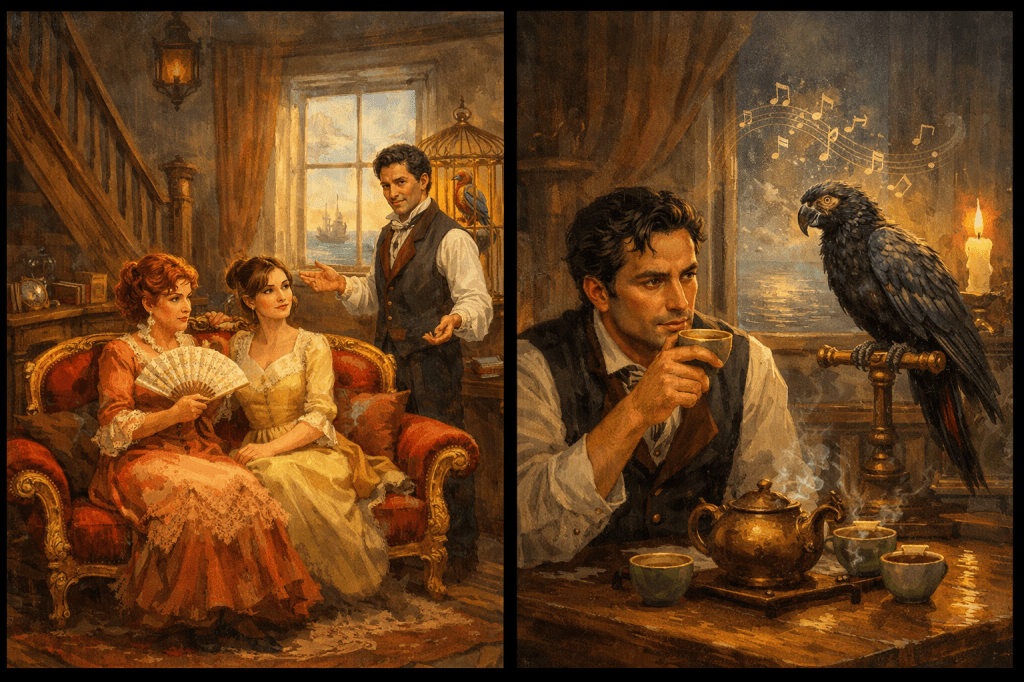
“Dear Mrs. Macchiato, please—sit here. It is by far the most comfortable of seats.” Maurice gestured with a smooth flourish and extended a guiding hand toward a plush red velvet loveseat, its gilt trim gleaming faintly, its cushions indulgently overstuffed. The room, though modest in size, was stylishly appointed—a delicate balancing act of parlor and office, suggesting both business and ritual.
A large wooden desk faced the only window, which offered a sliver of sea and sky beyond the quay. Across from it, a narrow staircase twisted upward, vanishing beyond the ceiling like a secret passage. Mrs. Macchiato followed the line of the banister with narrowed eyes and assumed—correctly—that it led to Maurice’s private quarters.
His sleeping quarters.
His bedroom.
She produced a fan, seemingly from nowhere, and began fluttering it with great purpose, as though warding off both heat and improper thoughts. Mrs. Macchiato imagined a great many things.
“And your lovely daughter may take the seat beside you,” Maurice added lightly. “There is plenty of room for two—though of course…” He paused, eyes twinkling, “…not always for agreement.”
He waved gently toward Anabel, who had remained silent but keen-eyed. Noticing the fan’s furious little weather system, Maurice leaned closer to Mrs. Macchiato.
“Shall I open the window, madam? It does get dreadfully stuffy in here when the air refuses to move.”
Their eyes met—Maurice’s dark and smoky, with a touch of mirth.
Anabel did not speak, but in a single glance her expression offered a dozen interpretations.
Her mother looked up quickly, gaze flicking between Maurice and her daughter, gauging and adjusting like a sailor watching the wind. Anabel tilted her head in acknowledgment of the seat. When her mother’s scrutiny returned to Maurice, Anabel allowed herself the softest of smiles—head still cocked, eyes sharp, curious, faintly amused.
Maurice could not, for the life of him, read her.
And that troubled him.
For while his success—by and large—was due to the curious talents of a feathered oracle, a healthy portion of it came from his own showmanship: his ability to read people, to sense stories before they were spoken.
He considered himself an open book. Yes—one he had written himself, with only the most flattering of footnotes. In his pages he was the hero, the poet, the Alchemist of Love, divining tea leaves and omens—or, at the very least, pointing to the parrot that did the actual work.
But she—Anabel—was closed to him.
Too forward. Too calm. Far too comfortable.
Which made him very uncomfortable.
“If you would,” Mrs. Macchiato replied at last—meaning the window, not the question—lowering herself onto the loveseat with a flutter of lace and peach-colored indignation. Her parasol rested against her knees like a delicate sword.
She cast her gaze around the room again. While the furnishings were tidy and the décor—if one squinted charitably—might be described as tasteful, her expression twisted with genteel revulsion.
Her face puckered, not unlike a prune attempting to recall its youth.
“I’ll put on the tea, shall I?” Maurice said, phrasing it like a question but already in motion. He darted to the small cast-iron stove tucked into the corner, where a modest stack of coal glowed faintly behind the grate.
With practiced efficiency, he set a bronze kettle atop the stove, stoked the coals, then turned to retrieve three cups and a silver tray.
“Apologies—no puffs or pastries today,” he called over his shoulder. “But should we meet your gentleman caller here, rest assured, there will be refreshments. Catered, of course. And a bit of whiskey or wine, if the mood leans more Dionysian than delicate.”
He glanced toward Mrs. Macchiato. “Some clients prefer to host these meetings in their own homes. Others—particularly those with estates—like to stage the encounter on their own turf. A romantic safari, if you will. Displays of acreage and ambition.”
Within minutes, he returned bearing the silver tray. Upon it sat the teapot—not porcelain, as one might expect, but a beautifully aged bronze vessel etched with floral motifs and small symbols of uncertain origin. It looked as though it had once been valuable to someone quite important… or at least someone who believed they were.
The teacups were striking in their simplicity: small, handleless, fashioned from glazed clay of gentle green—smooth to the touch, interiors dark as obsidian. When the tea was poured, pale steam curled upward, and the liquid shimmered like a deep, luxurious sea—green tea transformed into something mysterious and inviting.
Maurice took a seat in a simple wooden chair opposite the loveseat, his cup cradled in one hand like an offering of diplomacy.
For a moment, silence reigned—the kind laced with possibility and judgment—each participant sipping and wondering at the peculiar arrangement they were now, however hesitantly, entertaining.
Then Mrs. Macchiato cleared her throat.
It was not a delicate sound, but a declaration—fanfare, Maurice thought—like the brassy blare that precedes a royal entrance.
“Mr. Matchmaker,” she began, fan already fluttering, “I have been tracking news of your arrival.”
With all the subtlety of a bounty hunter, Maurice thought, but did not say.
“In fact, your presence on the coast has produced a veritable wave of gossip. And from individuals I trust to be wholly honest, forthright, and discreet.” She leaned in, as though the room itself might tattle. “I must say—some of what I have heard, if true, would prove to be… highly distressing.”
Again, she waved the little cream-colored fan, now pulsing with hummingbird urgency.
Maurice sipped his tea, unbothered. “Yes. Most rumors travel most rapidly among the most discreet, do they not?”
“The tea is quite good,” Anabel interjected.
Maurice raised an eyebrow. “You sound surprised.”
“I am,” she replied with a shrug, gesturing around the room. Then—without quite meaning to—she gestured toward Maurice himself.
Maurice, who had been leaning forward expectantly for a compliment, straightened as if struck and released a small cough of indignation… followed by a chuckle.
Next time, he thought, I’ll wear my lucky gray vest.
Mrs. Macchiato seized the lull to retake the conversational reins.
“I have heard—from reliable sources, mind you—that you have been involved… ahem… with several of the women for whom you’ve been hired to find husbands.” She drew in a breath sharp enough to slice fruit. “And indeed, sir—some of their mothers.”
“Mother!” Anabel gasped, scandalized.
“Well, it is what I have heard,” Mrs. Macchiato insisted, the fan now a blur of lace and righteous fury.
Maurice stood abruptly.
Both women expected a vehement denial. A theatrical protestation. A refusal to have his noble intentions questioned.
Instead, he offered a surprisingly level gaze and said, “I’m quite certain what you’ve heard has been… exaggerated.”
He paused—just long enough for hope to bloom in the room.
“I have, on rare occasions, found comfort—and recreation—in the company of an adult who once happened to be a client. Or a client’s daughter. Or a client’s sister.” He lifted a finger, as though making a point in a lecture hall. “But never while their future was in my hands. I may be theatrical, madam, but I am not unethical.”
Mrs. Macchiato inhaled so deeply that for a moment it seemed all the oxygen in the room had gone directly into her corset.
At that precise moment, Kodao let out a delicious, perfectly timed cackle.
“Come, Anabel! We are leaving!” Mrs. Macchiato erupted, rising like a peach-colored storm cloud. She snapped open her parasol and held it before her like a holy relic, warding off the lingering effects of Maurice’s charm.
Anabel teetered on the edge of a laugh and a gasp—equal parts drawn in and aghast. But before she could speak, she was seized and whisked toward the exit.
Just before passing through the door, Anabel twisted free of her mother’s grip and turned back. Her eyes locked with Maurice’s, and on her face was a look neither of them could name.
Curiosity. Understanding.
Perhaps even a warning.
And that’s when Kodao sang.
Kodao did not sing. Kodao judged. Kodao squawked, commented, and sometimes even condemned.
But this—
Not a squawk. Not a trill.
A song.
A beautiful, spiraling chorus of notes neither of them had heard before—melodic yet wild, rising and falling like wind through glass chimes, a sound that made Anabel’s breath catch in her throat.
She looked at the bird. Then at Maurice.
Their eyes met again.
And just like that, the song ceased.
A peach-covered arm swept backward into the room, seized Anabel by the wrist, and—poof—she was gone.
Maurice was alone.
Except he wasn’t.
Kodao remained silent now.
Watching.
And Maurice felt something he had only ever witnessed from the sidelines of other people’s lives.
It wasn’t loneliness.
It was something far more treacherous.
It was the ache of proximity.
The weight of something real.
And it was crushing his heart.
 T.L. Johnson