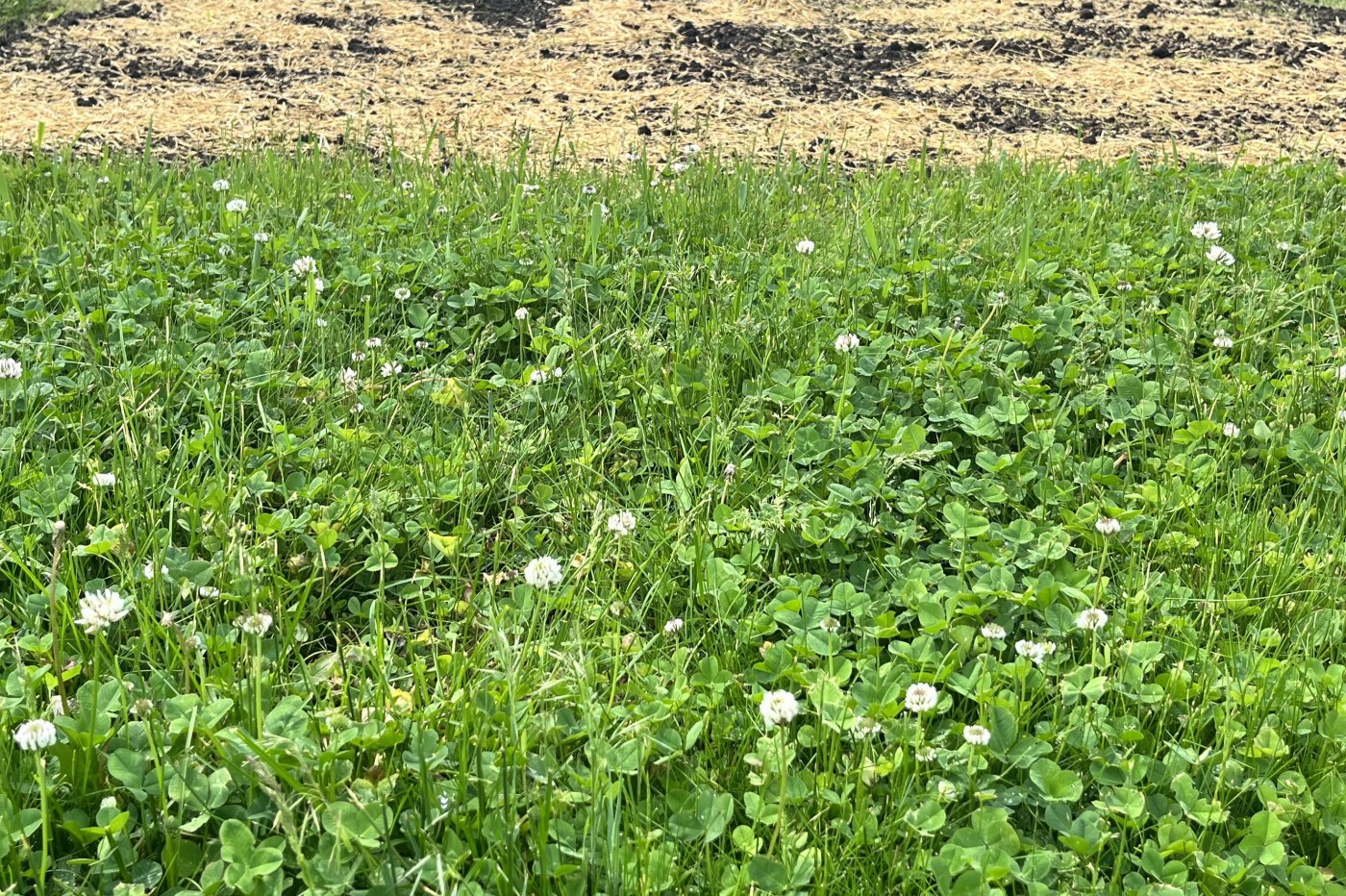
The white clover is in bloom! The dandelions have had their day. You can read about my thoughts on how dandelions should be used to bridge the gap between early spring, when pickings are slim for early arriving pollinators, and later in summer, when a multitude of other blooms and food sources are available for pollinating insects in my article Giving the Dandelions Their Day in the Sun.
Many of the indigenous bees emerge early in spring and go off searching for sustenance. Due to habitat loss, they have a tough time finding sources of nectar. Consider for a moment that in Wisconsin, 80% of the land is privately owned. Most of the 20% that is public is far to the north. Therefore what happens on 80% of the land is up to the whim of the individual landowner and human aesthetics, which are not always in line with the needs of the flora and fauna of our natural environment. And, of course, there is economic pressure to profit from exploiting and extracting natural resources with a growing disregard for long-term environmental impacts.
In southeastern Wisconsin, the latest glaciers deposited the ground-up particles of rock after massive ice sheets scraped them up along their southern trek approximately 1000 years ago. The land in the south of the state is relatively flat and has excellent soil for farming. On its eastern flank, It also abuts Lake Michigan. There settlers established a port city, and the area enjoys the highest concentrated population in the state. Suburbs spread over a hundred miles in all directions except east. Remember Lake Michigan. Southwest and central Wisconsin have less human density but more corporate farms, and there is no sanctuary for flora or fauna to be found there either.
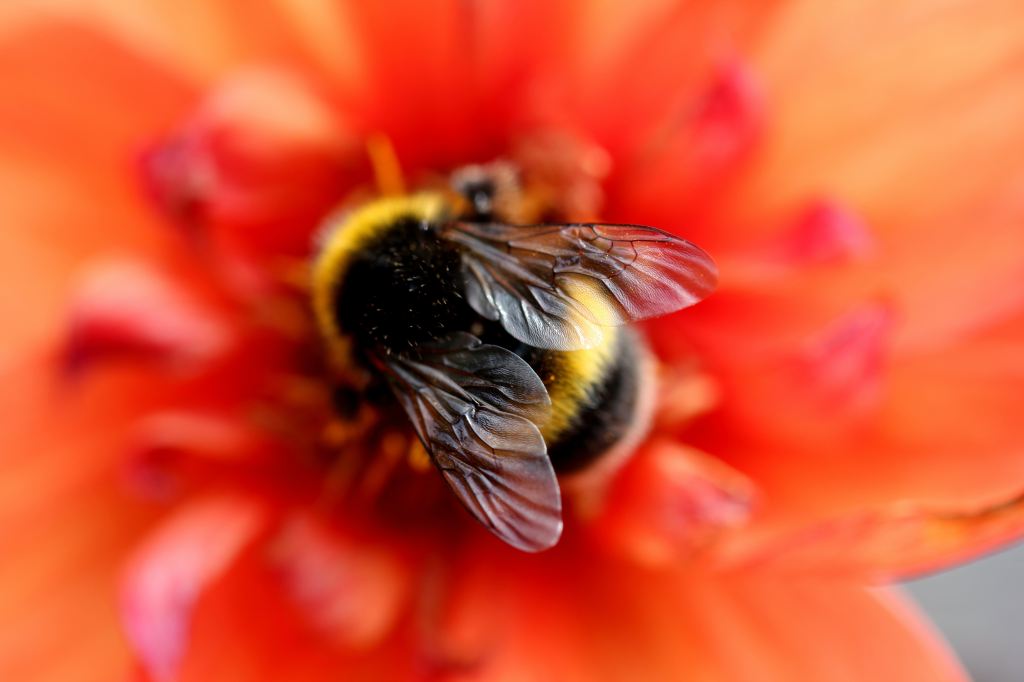
What is a bumble bee to do? The bee wakes from hibernation, crawls out of the ground, and heads out only to find the fields where it found nectar last year have been converted to a subdivision. Or the hedgerows where it once found sustenance buzzing from one flowing plant to the next have been cleared and tilled. Put into production—nothing but fresh sod, green dead zones interspersed with farm fields sprayed with lethal chemicals. There is no joy to be found there.
Driving home from the farmers market this past Saturday, I noticed the purple, pink, and white flowers of the Dame’s Rocket stretching upward along the highways and byways of our drive. I initially thought these flowers were phlox, but I suspected they were an invasive species due to their location on the side of the road. Invasive species tend to be very good at establishing themselves quickly on disturbed soils and are usually very efficient at seed dispersal. Dame’s rocket is an alien species from Eurasia. Its colorful flowers are sometimes included in seed packets and misguidingly provided as wildflowers.
According to studies, 90% of herbivorous insects are dependent on one of just a few native plants to provide their food. They are much more likely to be attuned to plants they have co-evolved with over the millennia than new imports from foreign lands. It seems obvious, but having removed natural habitats and replaced them with agricultural fields where we quite actively and intentionally kill the insects or alternatively plant the lands in turfgrasses which hold no value to the local insects, people are still surprised when made aware of the extent to which the insect populations have fallen. And in decline along with them are the insectivorous birds dependent on the insects for their nutrition.
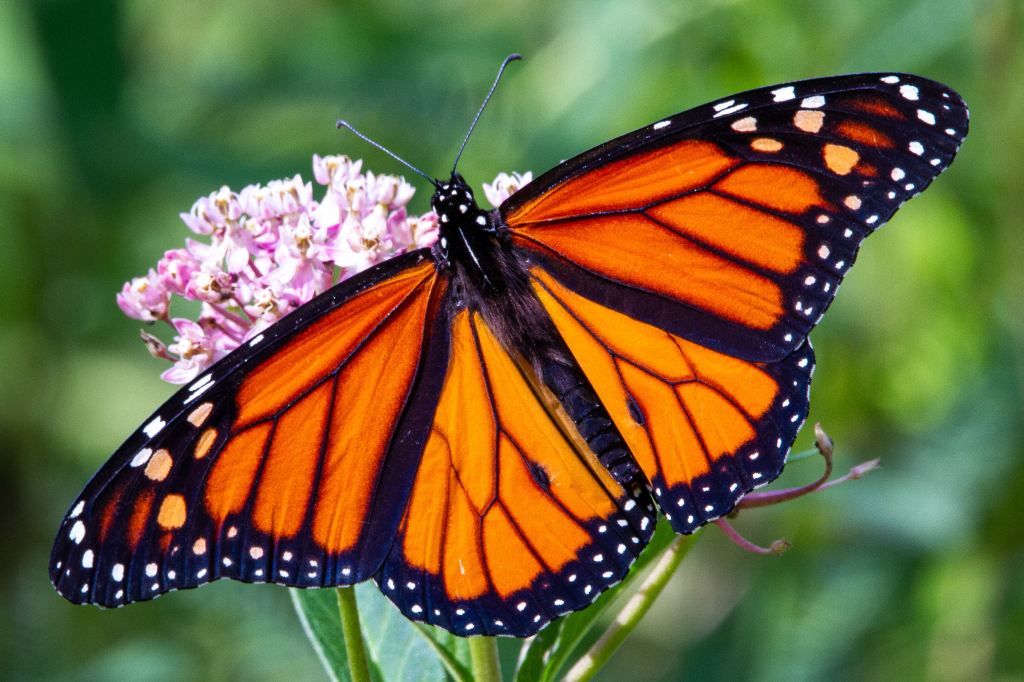
Estimates range widely, but there is a clear consensus that insects are in sharp decline. Generally, numbers are sited above 30% decline over a twenty year period. Some species, such as the Monarch butterfly, are experiencing a 68 % decline, and the bumble bee has gone extinct in 8 states. And only holding on by a thread in New York state. The American bumble bee has declined by over 50% here in the Midwest.
We have heard a lot about the plight of bees in the news. But what most of us fail to recognize is the stories are often referring to the alien species of bee. The honeybee, which is a European import. And yes, the loss of the honey bee is a concern we should all pay attention to, but it is only one foreign pollinator, and we have thousands of local insects that pollinate much more efficiently, and they, too, are under attack. I will discuss this more in an article on From Bees to Honey.
We have begun to put portions of our lawns to good use by converting them to bee lawns. What exactly is a bee lawn, you ask. By now, you have heard of No Mow May. Sometime in early May or April, if you are reading this further south, you will want to let the dandelions have their day in the sun. And after their early season flourish you can raise the deck on your mower and cut down the flowering stalks. Your lawn will be green and healthy, and you will have aided the local pollinators get through the lean times of early spring. And when the dandelions have waned, the sections of white clover and self-heal, low-growing flowering perennial ground cover will bloom and start another food source for local pollinators.
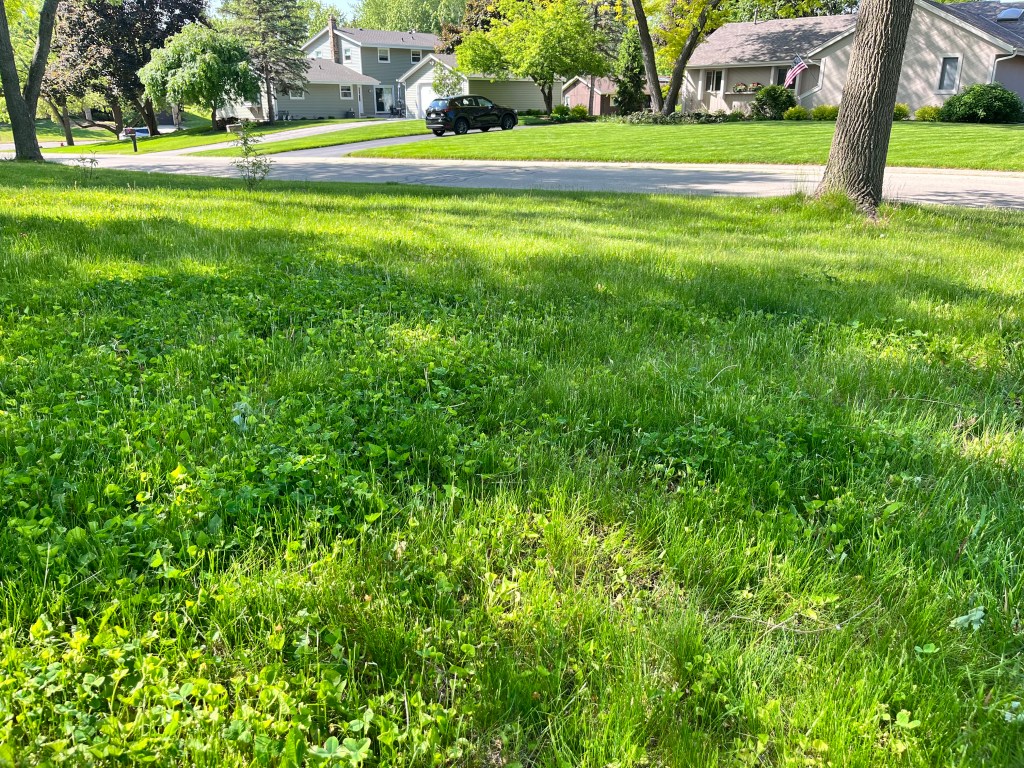
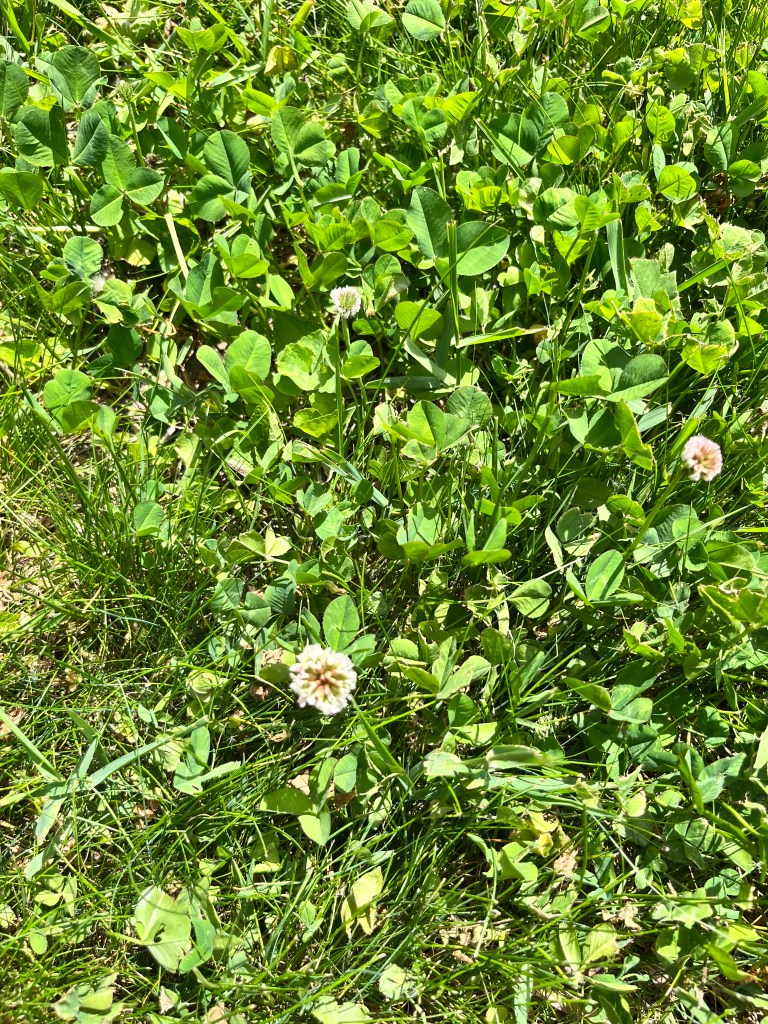
This picture shows my lawn in late May. You can see the clover, but there are very few if any, dandelions to be seen. Earlier articles document the yellow manes’ appearance in early May. Dandelions are early emerging. They find it hard to compete with the turf grass once it starts to grow in earnest. So, don’t be afraid to Give the Dandelions their Day. You do not have to poison them.
What Exactly is a Bee Lawn?
A bee lawn is a lawn where you intentionally grow low-growing nectar-providing plants in and amongst the turfgrass to give your yard the appearance of a lush green flat expanse of the American Dream and in doing so, provide a buffet for bees.
As with creating a perennial native garden, you need to give the clover seeds a fighting chance against the entrenched turfgrass. Our first Bee-lawn came in the shape of a circle. That is where the dirt delivery was made, and when we finally got down to the bottom of the pile, I raked it flat. The grass had been killed by the lack of sunlight as it lay under the pile of dirt for a month. Bum leg, remember, and a bum shoulder or two. It just goes to show you anybody can do this. And probably much easier and faster than I did.
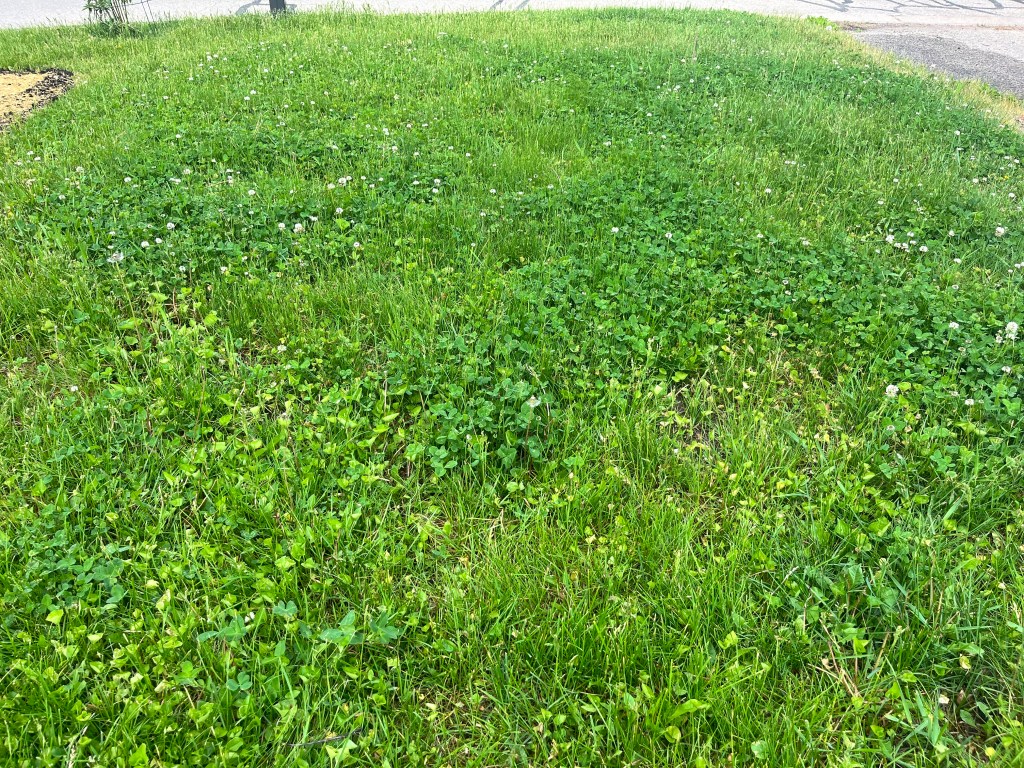
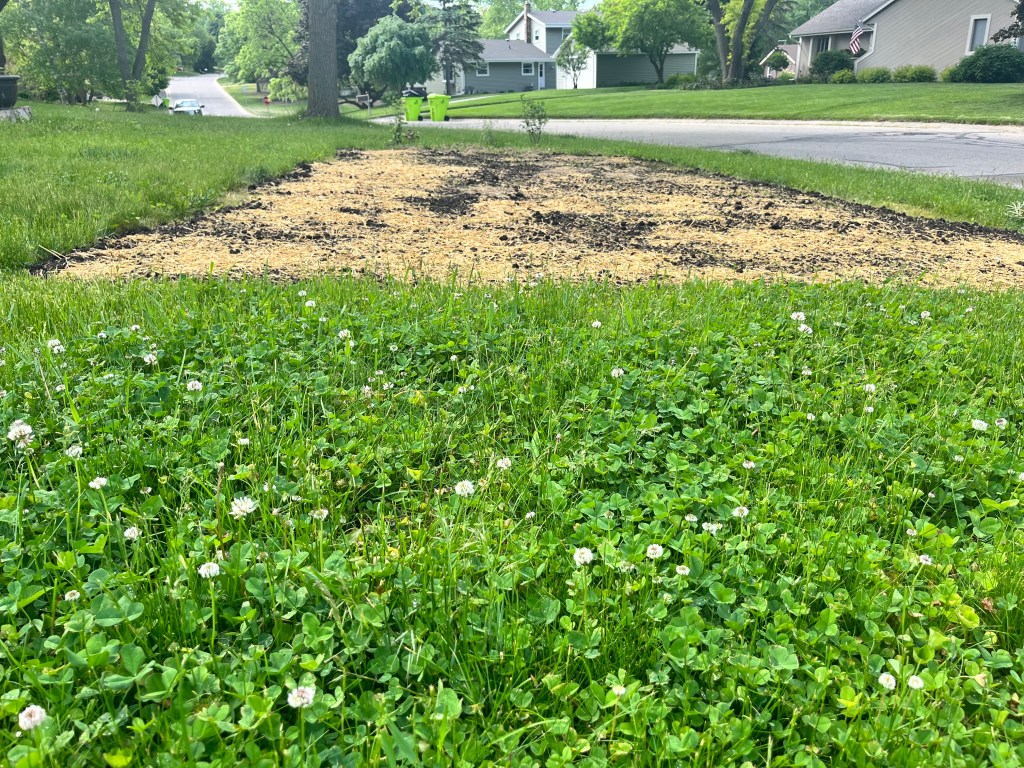
So, I seeded the area with a bee-lawn mix. Twin City Bee Lawn seed mixture. I then applied a thin layer of hay to help retain moisture as the seedling sprouted. Then you do have to water it once or twice a day depending on precipitation and temperatures. Above is a picture of it in late May. You can see the white clover is blooming.
I overseeded parts of the lawn as well, with mixed results. The clover has done well in the shade, but in the sunnier areas, it could not compete with the existing turf lawn.
The white clover came up well in some areas, exceptionally well in the adequately prepared circle next to the driveway. Within the seed mix, you will also find a small, low-growing purple flowering plant called self-heal. Fescue, a type of grass, and creeping thyme, another low-growing flowing ground cover, completes the mix.
We are increasing the size of the bee lawn, as shown in the following pictures.
Installing a Bee Lawn,
The Groundwork. Preparing the site.
First, I cut the grass several times, lowering the deck until it almost scraped the ground. Then I vigorously raked the area with a stiff-pronged rake.
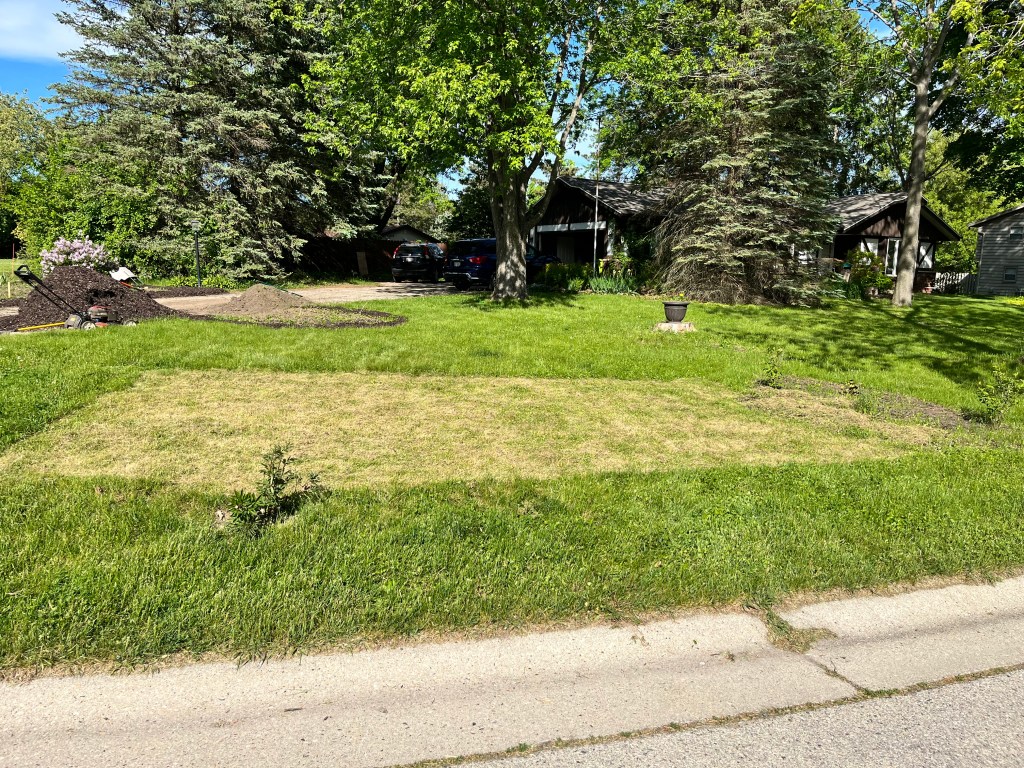
As an additional step I added an inch or so of soil on top before seeding the area. So, my son, (thank you Tristan) moved the dirt for me.
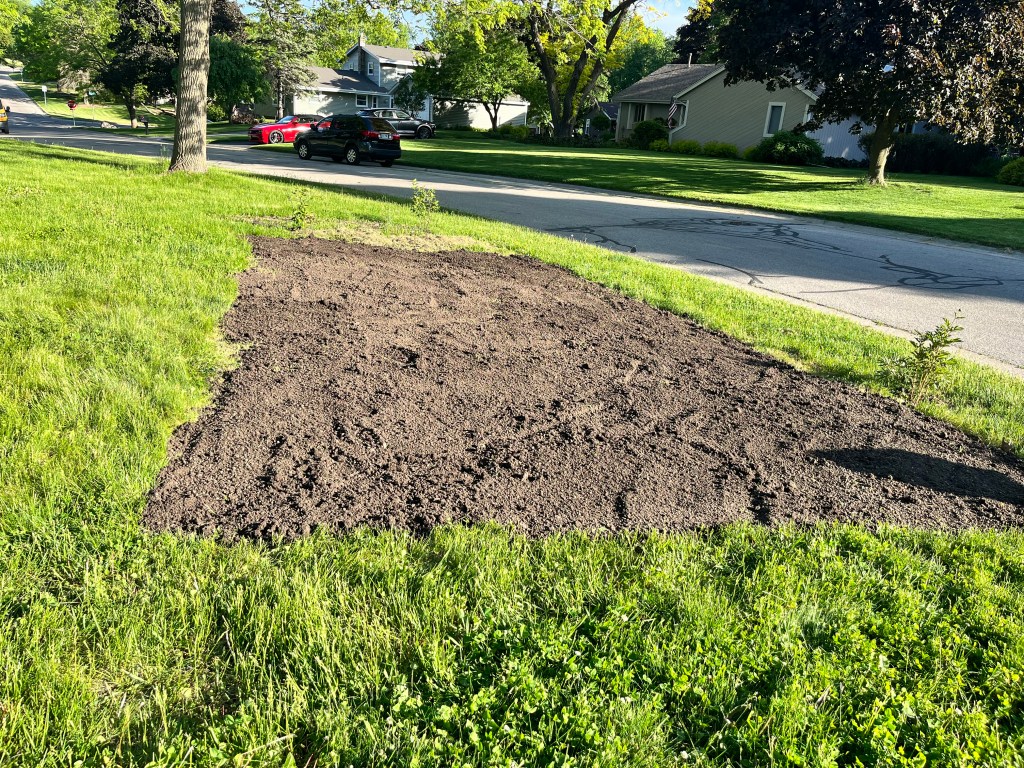
Sowing the seeds
My wife Terri sowed the seeds by hand, dispersing them evenly over the expanse of dirt, but I set up the sprinkler. And turn on and off the water.
Care and maintenance of your Bee Lawn
Now, I will water appropriately—usually, early morning and late evening depending on precipitation and temperatures. I will keep you up to date with the progress.
The best time to plant a bee lawn is in the fall, so if you were thinking that it is almost summer and you missed your opportunity, you haven’t. Though you may want to lay down that cardboard at the beginning of August and go ahead and kill the grass in the area, you plan to seed. Eliminating turf grass will increase your chance of sprouting a bee lawn next spring. See Do as I say not as I do, for more information on starting a native perennial garden.
To care for the bee lawn, I set the deck of my mower to its highest level and cut the area when it starts to look shaggy. Approximately every two-plus weeks. I judge this by the height of the clover and try to maintain appearances. My bee lawn is front and center in my front yard.
Advantages of a Bee Lawn.
Overall, once established, the clover is more drought resistant than turf grass, and it actually produces nitrogen fertilizer for your soil. You heard that right. The clover puts fertilizer into your soil.
The clover has a Rhizobium bacterium living in its roots. The bacteria live in a symbiotic relationship with the plant providing nitrogen for the plant to grow while receiving nutrients from the clover. Nitrogen is an essential fertilizer for plants. Roughly 80% of the air is nitrogen, but plants and animals cannot access it from the air directly. If we could, we could just build muscle by breathing in air. Which it appears I do when having my picture taken, but I assure you that it is just me sucking in my stomach and filling my lungs with air and giving the appearance of musculature.
Plants need the bacteria to “Fix” the nitrogen into a usable form. We, on the other hand, need to eat plants or eat animals that have eaten plants to get the nitrogen required for our bodies to function. We need plants. The plants need the bacterium. Just like plants need pollinators to reproduce and produce seeds, grains, and fruits. We need pollinators to help produce the foods we eat. But we single-mindedly set out to kill them at every turn. I think we can do better.
Overall, once established, the clover is more drought resistant than turf grass
Clover enriches your soil by adding nitrogen to the lawn.
A small bee lawn can help. It does not have to be large to be impactful. And if you don’t have a lawn, consider your choices of potted plants for your doorstep or patio. This is something we can all do.
Thanks again for tuning in. Please take a moment to like the article and subscribe to my website here or at Terryjohnsonauthor.com.
 T.L. Johnson
Leave a comment