
The rays of sunshine travel 93 million miles in eight minutes and twenty seconds and land upon your lawn. These rays of sunlight are not the sun’s heat or thermal energy but a form of energy called electromagnetic radiation – a kind of radiation including visible light, radio waves, gamma rays, and X-rays, in which electric and magnetic fields vary simultaneously.

In today’s article, you will learn how sunshine can be turned into Sweet Dandelion Wine.
This energy from the sun travels not coincidentally at the universal speed of light. It can move unaffected through the medium of space. Things start to happen when the light rays interact with matter, such as when they travel through the Earth’s atmosphere. Here is a particularly pretty sunrise I captured in May of this year in Northern Wisconsin.
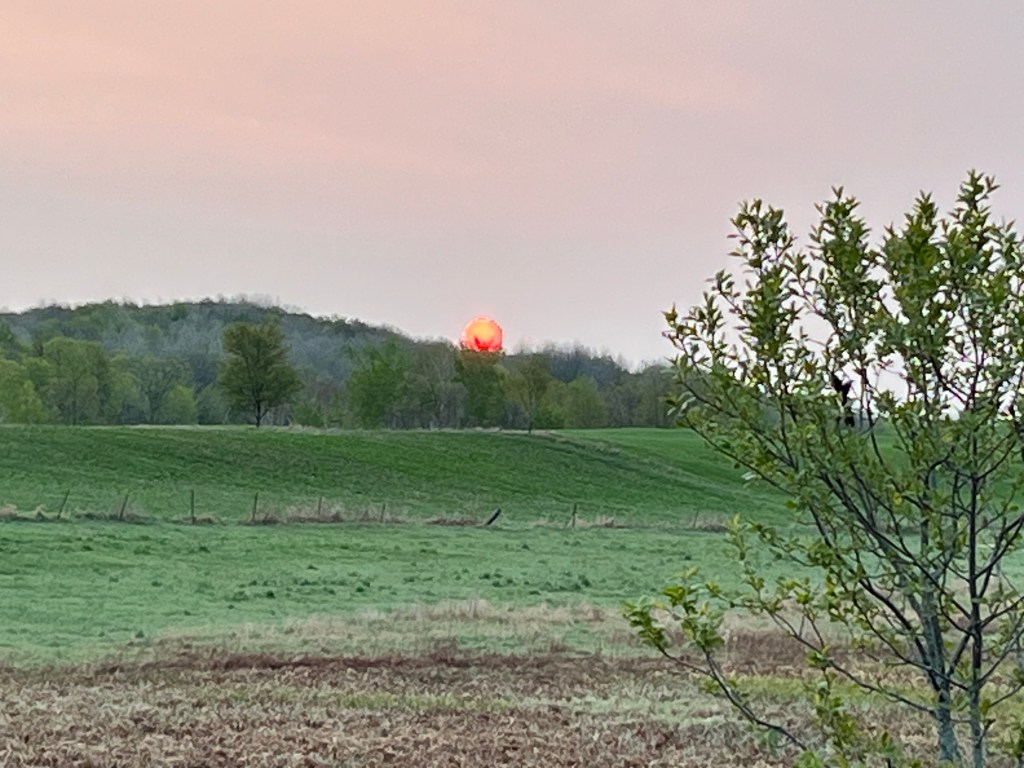
As the sun rises, the light rays pass through the atmosphere at an angle. The shorter blue-light waves scatter more easily than, the longer red-light waves. More red-light waves reach your eye at sunrise and sunset.

The waves of electromagnetic radiation are a form of energy that powers almost all of life on Earth, with the exception of a few microorganisms that can survive by consuming chemicals, which live deep underground or deep under the ocean and are called chemoautotrophs.
Photosynthesis
If you are lucky, and a growing number of us are. The sunshine lands upon a lawn free from harmful chemical use. It will fall not only upon the perennial turfgrass that still forms the foundation of some areas of my yard but also on dandelions that sprout in early spring. The rays of sunshine are converted to the bright yellow flowers of the dandelions through the process of photosynthesis.
The light is captured by the toothed leaves of the plant, and the wave of energy is converted into chemical energy by pigments within the leaves, and when water is split within the leaves of the plant, electrons are free to move about. (Vast oversimplification, but electricity is moving electrons) This captured electron begins a cascading biochemical process that allows the plant to capture the CO2 from the air and use hydrogen from the water it split earlier in the process; it then binds them together to form building blocks of matter. A Glucose Molecule. C6H12O6. Simple Sugar. This process gives off O2 as a byproduct. Lucky us!
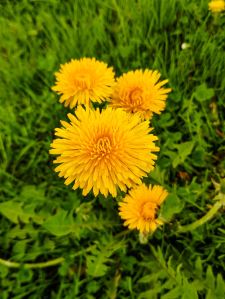
I pick the bright yellow flowers of the dandelion and capture some of the sun’s rays. I can use the sugar molecules within, and some added sugar cane to transform the simple sugar into alcohol.
On the molecular level, it is a simple thing that the organism Yeast does naturally. The C2H5OH has all the same essential parts, just arranged slightly differently. You can still see the carbon dioxide in there and the water. They have just been chemically rearranged.
This process is called fermentation. Humans use sugar and the oxygen we breathe to produce energy. The product, of course, is released in our breath – Carbon dioxide and water.
Yeast use sugar in a similar way but without the oxygen. They produce carbon dioxide (the bubbles) and alcohol as a byproduct. We will take advantage of this property in making the dandelion wine.
Wine became a part of everyday life early on in human history because, in many cases, it was safer and more nutritious to drink than the contaminated water source. By the way, we are, as a society, are currently leaching millions of tons of fertilizer into our waterways and aquifers, contaminating the environment by applying shockingly massive amounts of chemicals on our lawns in our quest for the perfect lawn. I think we can do better. Don’t you?

So here’s to sunshine in a glass.
I toast the lowly dandelion; may its sunny yellow flower find a place in your wine, heart, and yard.
Below is a recipe shared with us by my friend Mary. Please let me know how it turns out. If interested, you can learn more about dandelions and yards by looking at my Biodiverse Landscape blog Listening for the Sounds of Summer.
Rose Swanson’s Farmhouse Dandelion Wine
1 qt. Packed dandelion blossoms
Pour 1 gal boiling water over these, let stand about 3 or 4 hrs. Stir a couple times.
Then when time is up, strain and put into a good size crock.
Add
3 lbs. sugar
1 large orange sliced
1 large lemon sliced
1 cup washed raisins
A small amount of yeast
Stir and let work a couple weeks
Strain and let work until it quits, takes about 6 weeks
Siphon and bottle this “to age”
==========
This recipe is transcribed almost verbatim from one of her treasured hand-written recipes. I remember decades ago when my Grandma Rose made it. Strong and sweet. Sometimes she would ask me to help by gathering the dandelion flowers from her yard. Since then, I’ve thought of her dandelion wine whenever I see a dandelion in bloom. I made my own batch last year, and it tastes surprisingly not bad.
Notes: I used 1 packet of Lalvin EC-1118 yeast and a 2-gallon plastic wine fermenter (not having a ‘good-size crock’ on hand).
-Mary Swanson
Mary added – “Thinking about the recipe, I’d like to rename it “Rose Swanson’s Farmhouse Dandelion Wine” to point to its rustic/simple nature. (Most modern wine recipes talk a lot about sanitizing, additives, yeast nutrients, etc., but I doubt Grandma Rose worried too much about any of that, and it seemed to work out fine). I didn’t want to get into the weeds on that (ha!), but perhaps there are more ways to suggest the idea that more info is out there on best practices for winemaking)”
Mary, thanks for adding the pun. Here is a list of things to keep in mind.
Start with Dandelions from an area where you know chemicals are not sprayed.
Use the Yellow flower petals only. Do not include the green parts. (they will add bitterness)
You can use a “goodsize crock” with a towel over the top, which you stir daily, or a Carboy with an airlock on top.
Place in a cool area and let this sit until bubbling stops. 10-14 days.
Strain through cheesecloth before bottling. You can then let them finish in a wine bottle. Place a deflated balloon on top with a small pinprick to release gas. This will keep out dust or bugs as well.
Age the wine for a bit. It might be hard to wait but wait at least a couple weeks minimum and up to more than a year if you like.
The Spruce Eats provides some details on using more modern winemaking methods.
If you enjoyed the article, please let me know. If you subscribe, you will receive my latest posts directly to your email. And check out my Author Page at Terryjohnsonauthor.com. Thank you for your support.
 T.L. Johnson
Leave a comment