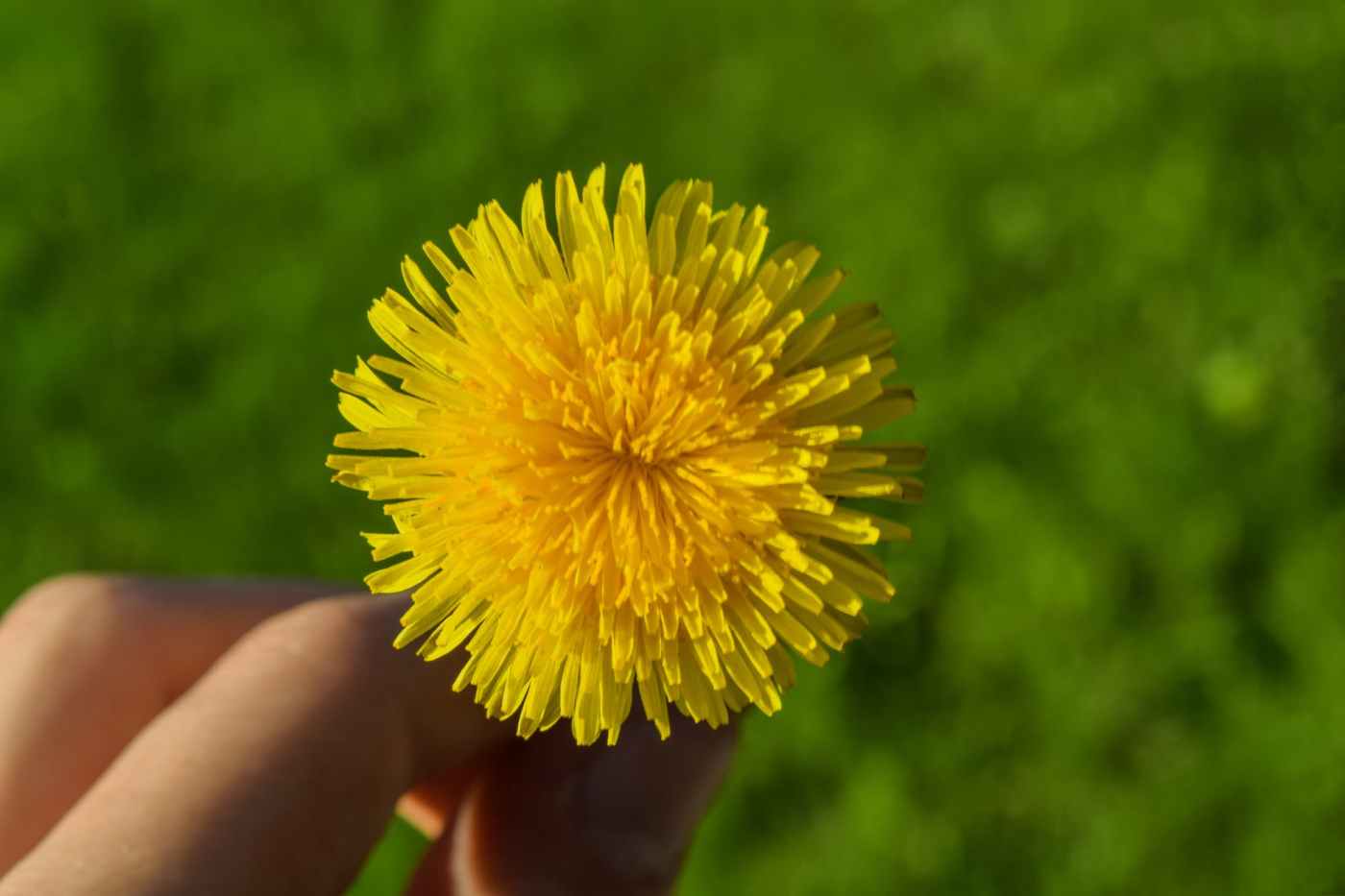
Originally I meant to include this article later in the series, but I realized this week as I took pictures of my yard and compared them to the Guy next door that the dandelions were doing their job and needed this article now. I know the spring has been in full bloom in the southern states for more than a month, but here in Wisconsin, the dandelions have just finished with their first full flourish.
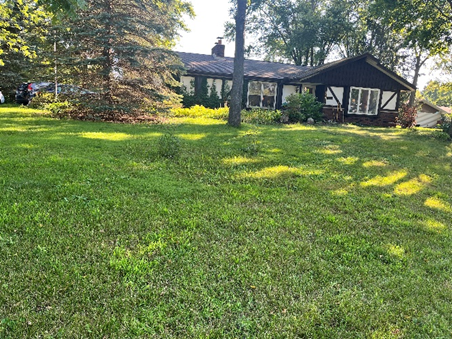
And I know having dandelions in your pristine lawn is a step too far for some of you. I totally get that but listen carefully. As well as the dandelion blooms in May and lingers a bit into June, it will be absent from the lawn in summer. That is why I was going to wait. To show you the proof in the pictures. If you use organic slow-release fertilizer on the area of your yard you maintain in turfgrass (including bee lawn), you will see the grass will out-compete the dandelions as the summer months progress, severely limiting their numbers.
There were a few dandelions mixed in July, but here is a picture from August.
Keep in mind, that
“Already the dandelions Are changed into vanishing ghosts.”
– Celia Thaxt
But aren’t dandelions weeds?
Yes, Dandelions are, in fact, weeds. They are alien species. But before I go into all that, I would like to pause to let dandelions have their day.
An Ode of sorts to this Yellow Dapper Dandy.
A field of green dappled with bright yellow manes.
The Dandelions roar into spring.
Many see it as a blight upon the land when in reality, it is a lifeline, a bright yellow beacon of salvation for the early emerging pollinators of spring.
I see flashes of flittering insects hovering and fluttering between the sunlight-yellow spheres that populate the front yard. The insects see an early and readily available food source that will feed them until the other nectar sources become available. In the ultraviolet they see a target that says open for buzzzness. The bumble bees, the indigenous solitary bees like the carpenter bee, the mining bee, the sweat bee, the mason bee, and the domesticated honey bee (from Europe) all see the dandelion as a lifeline to get through the early spring days. And they are not alone. There are butterflies and hoverflies and beetles that rely on the yellow sparks of spring to bring them to the summer cacophony of blooms that summer offers.
The dandelion’s name should be held in high regard. The tooth of a lion. For its serrated and toothed leaves. Dent de lion, in French. In the mid sixteen hundreds, European settlers intentionally brought the plant to America. It was used as a food source and a medicine.

“Dandelions, like all things in nature, are beautiful when you take time to pay attention to them.”
Stoyer.
We will touch on the topic of weeds more in our journey to produce a biodiverse habitat in our landscapes. Let me introduce the concept of the
A weed – a plant that grows where we don’t want it to.
The dandelion is seen as a weed by many. And while it is an alien to our shores, it is a helpful species.
Insect and bird populations are in decline. Several factors are contributing to the decrease in biodiversity. Two of the most significant contributing factors are the poisons we use to kill them directly. I am talking about pesticides and habitat loss.
The lawn is a monoculture of green. It provides no food or habitat for insects or bird species beyond the worm-eating American Robin. And at the same time, it is a magnet for the application of poisons that actively kill the insects that dare pass through the landscape. Maintaining pristine turfgrass lawns also is responsible for killing entire ecosystems, as we will discuss in later chapters.
The No Mow May movement is in response to this realization. It is a simplification of the use of alliterative verse to catch our attention. And now I’ve heard of the No Mow till Mother’s Day put out as an alternative. My own iteration of the alliterative verse is Give the Dandelion its Day.
They have, actually. April 5th is National Dandelion Day. The principle message is the same. Mow less. Grow more low growing pollinator supporting plants in your lawn. Let the Dandelions have their day. Let them assist the bees and butterflies through the spring.
You can do this by mowing less, letting your grass grow a bit taller, say 4 inches. Stop spraying poisons that kill plants and insects. Both of those steps would cost you less and pay you more. The biodiversity of your yard would improve without you lifting a finger.
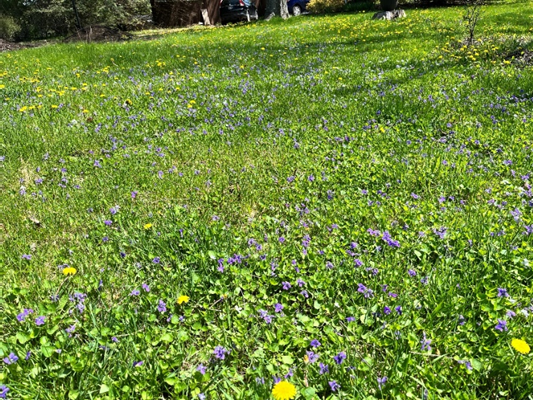
You could, of course, overseed your existing lawn with bee lawn seeds as I did. Bee lawn seeds contain grass seeds, as well as creeping thyme, self-heal, and clover, all of which form low growing nectar producing plants that can nestle into the lawn and produce food for pollinators throughout the growing season. As evident in this picture, the results can be seen in as little as one year.
“If dandelions were hard to grow, they would be most welcome on any lawn.”
― Andrew Mason
I will post soon on how I accomplished this in my yard, but for those interested, refer to the link provided. University of Minnesota Bee Lawn page.
You don’t have to leave your lawn for the entire month of May. And if you live in the south, you may want to consider leaving your lawn grow long in April. Cutting it every two weeks and letting it grow to four inches in height will be a good start.
That is a great start. Now we can get busy building our biodiversity and provide a landscape that will provide food and habitat for multiple species of insects and birds. Thank you for joining me as we, Listening for the Sounds of Summer.
“Dandelions are just friendly little weeds who only want to be loved like flowers.”
― Heather Babcock
 T.L. Johnson
Leave a comment