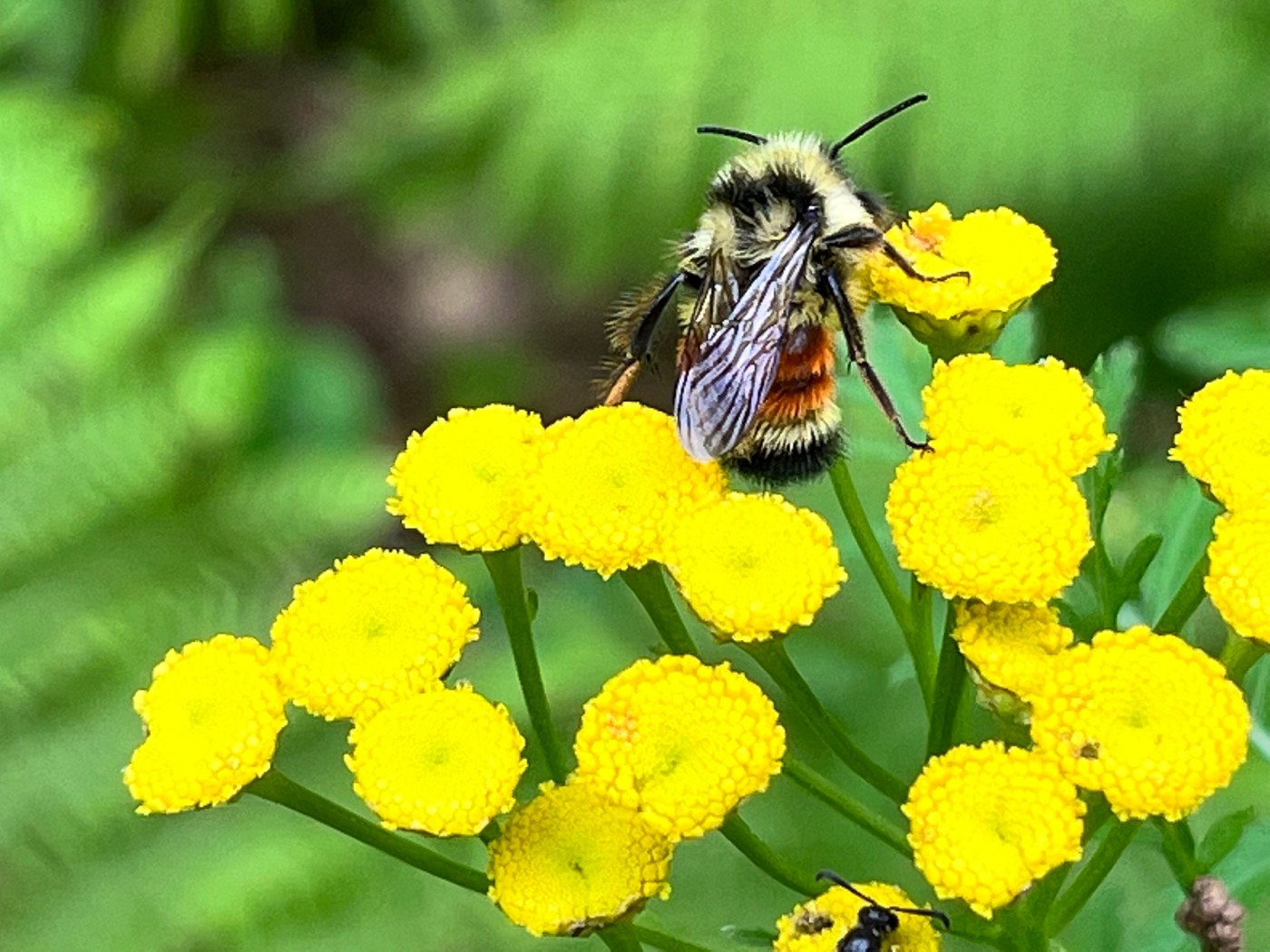
Kill your lawn.
Yes, you read that correctly. Before you start your native plant perennial garden, make sure to kill the grass! No matter the size you are planning to install. Kill the grass first.

I am not a gardener. Wait, I looked it up. Definition Gardener – a person who tends and cultivates a garden as a pastime or for a living. So, I am a gardener, though one of the order of nonprofessional gardener varieties. I should have started with the fact that I am not a professional gardener. There are plenty of books and websites out there that will provide you with gardening advice. I will also provide you with gardening advice, but I will mostly tell you stories and talk about how and why we must do away with lawns and convert our monoculture lawnscapes to more biodiverse habitats.
I will reference professional gardeners and provide links to useful and informative resources. I am a writer. I was a science teacher. I have several science degrees, including biology. I mention this so you are aware right away, right up front. I know some stuff. I taught some stuff, and I know how to find stuff out. But I don’t know everything.
A few years before I came up with the idea for the book Listening for the Sounds of Summer, I had decided to let the strip of lawn next to my driveway grow wild. I now know there is a movement called rewilding. This wasn’t that, exactly.
Rewilding – restore (an area of land) to its natural, uncultivated state – used especially with reference to the reintroduction of species of wild animal that have been driven out or exterminated.
I just thought it would be good for ‘Nature’ to have a bit of my yard to, you know, grow and live in. No plan, just a hmm. I think I will let the bit grow wild.
I liked the look of it, my wife questioned it. But I cut it back a couple times during the summer that first year, and then the next, I let it grow and only cut it back in the fall. It was definitely wilder looking. It didn’t really lead to any revelations. The grass grew longer and flowered. I liked it, my wife questioned it.
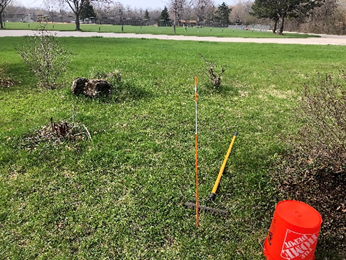
The pictures above show the area I let go wild. As you can see, it was mowed by this point. My wife was questioning it.
For the Project, I decided to turn the wild area into a butterfly or pollinator area, creating a more flowering native plant pollinator vibe.
It worked, kind of. I was a pretty good gardener. I planted things. They survived. I planted tomato plants, and they produced more tomatoes than we could eat. The same with lettuce, beans, peas, and peppers, you know, the easy stuff. I thought I could convert the strip of lawn next to the driveway by spreading seeds and planting a few bulbs, and when that failed.
Look, I know all about how plants grow. I had picked seeds of plants that were native to the Midwest. I watered the landscape and provided all the things plants needed to succeed. But I didn’t remove the turfgrass first. I assumed the seeds and bulbs would sprout, and then I would use the hoe, shovel, and weed around the flowering plants. You know, help them out once they got started. By the way, if you haven’t used a hoe, you are missing out. You’ve got to get one. Check out videos on their proper use and then start hoeing. It is the best. The way that sharp edge cuts deep into the soil and effortlessly severs the roots of that clump of grass or unknown plant in our garden we call a weed. Hoeing, for me, is a sublime form of meditation. Much better than bending over and trying to pull weeds by hand.
The problem was that the grass grew very well, and no wildflower seeds germinated. Right now, you’re probably contemplating why you are even reading this book/blog. The first thing you find when you do a search on converting your lawn to a meadow is you need to do something about the grass. Well, I hadn’t read about converting my lawn to a meadow. I had read about the importance of using native plants in the landscape. I had read about the plight of insects and the catastrophic decline in pollinators. The decreasing numbers of birds. I consumed an incredible amount of information about the problem. Check out Silent Earth: Averting The Insect Apocalypse By Dave Goulson
Then I decided to do something about it.
Yeah, I should have probably done some more reading. I did but not on the topic of gardening. By this time, I was all in on the Project. I would document the process, the learning, and the results. I should have documented the planning. Or did some planning outside being inspired to be creative, My focus was on biological diversity and coevolution and not enough on horticulture.
I should have planned more.
The premise was that evolution had been doing what I was trying to do for a very long time and had been, until very recently, exceptionally good at it. Certain insects, birds, or bats pollinated certain plants. They had coevolved together over millennia. They were incredibly efficient at getting the birds and the bees thing done and producing future generations.
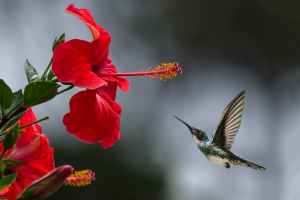
Philippe Donn on Pexels.com
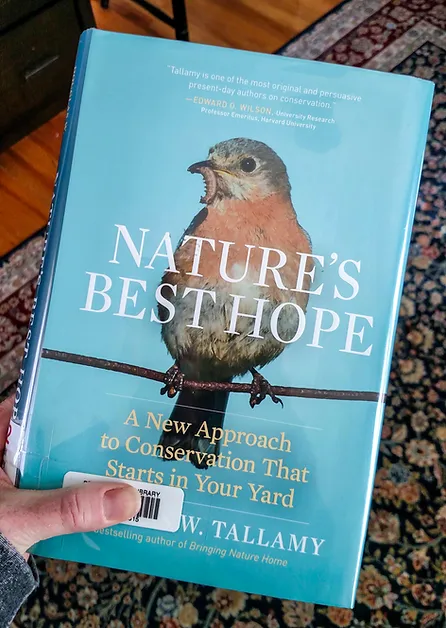
Douglas Tallamy has written several outstanding books on this topic. Nature’s Best Hope: A New Approach to Conservation that Starts in Your Yard and a Young Readers addition Nature’s Best Hope (Young Readers’ Edition): How You Can Save the World in Your Own Yard.
If you are a Gardener with a capital G or someone who loves reading about the environment, insects, and evolution, you might be better off stopping here and just ordering up one of his books. He’s a professor of entomology, but he writes clearly and well. I loved all his books. You will find some fine stories and a lot of interesting facts.
Here you will find many stories with a smattering of facts disguised as characters in some rather interesting stories. So, as I was saying, I screwed up, and you will, too, if you don’t remove the turf grass. That is if your goal is to have a native garden area, a pollinator garden, or, as in my case, a butterfly Air BnB. Ha, just made that up. An Air Bee and Bee or wait for it… Bee and butterfly. Who needs Tallamy anyway.
The grass is a perennial more on that later. Suffice it to say that grass has a head start on your seeds. It grows fast, but more than that, because it has all those roots ready to go, it grows faster than the seeds can germinate. Plus, there’s this thing about some perennial native seeds needing to harden over the winter. So, they won’t germinate in the spring you plant them. Oh, yeah, then there’s the thatch. The perennial grass grew last year. The grass that is cut dies and is deposited can build up over time. A little thatch can be good. It holds onto moisture and prevents the soil from drying out. Too much and even your grass will have a problem growing. The thatch limits the growth of our wildflower seeds by restricting the seed’s ability to come in contact with the soil, or it can also block its ability to reach the surface. Turfgrass just makes it hard for the seeds you spread to sprout.
You must kill the grass. This takes time. You cannot create a perennial native habitat overnight. Be patient. Do it right. Man! Where was I when I was doing this all wrong? I could have totally used my wisdom.
- There are several ways to remove the grass. At its fastest, this will take a few weeks. Using the slowest method, this will take a month or more. You can place a barrier over the grass for a certain amount of time and kill the grass by preventing light from reaching the surface. Clear or Black plastic sheets work very well for this. 6 Weeks.
- You can place cardboard down on the grass for a season. Place leaf mulch on top of the cardboard and let it sit. This works much like the plastic bag though a bit slower. One advantage is that you can dig through the cardboard to plant plants, and it is biodegradable. The second advantage is you are not using plastics. 6-8 Weeks
Of course, there is a fourth method. It involves poisoning the grass. Read David Goulson’s book Silent Earth before using this method. Also, read Listening for the Sound of Summer by Terry L. Johnson. You may have second thoughts.
Using toxins to kill the turfgrass and all the other perennials saves you less than half the time. So, what price is 2 more weeks? Is it worth the risk of poisoning an entire ecosystem, you, your neighbors, and everybody living downstream?
Wait, but I want to grow some native plants now!
You could start with a small area. In this case, you can use method 3. But there will be weeding to do. Clear it. Plan it. Plant it. By a hoe. (trust me) and weed it.
- 3. By hand. Using a sharp square blade shovel. After it rains, dig up the sod. Dig three or four inches down and flip it over to bury the grass. You can come by and chop up the soil as it dries to make it easier to work. This is not the recommended method as it will bring up a lot of weed seeds, and the disturbed soil is just the kind of place these pesky fella’s like to make their home.
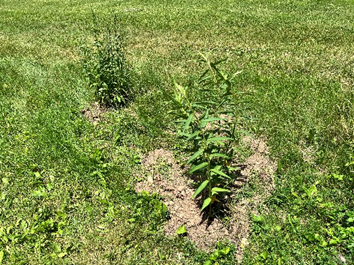
Having failed to have any of my wildflowers germinate and sprout I turned to planting native perennials within the lawn on the side of the driveway. I figured I would carefully manage the native flowers and help them overcome the lawn grass.
It worked, kind of. The plants prospered. I planted the following plants.
Above you see Goldenrod on the left and Milkweed on the right.
Purple cornflower
Echinacea purpurea
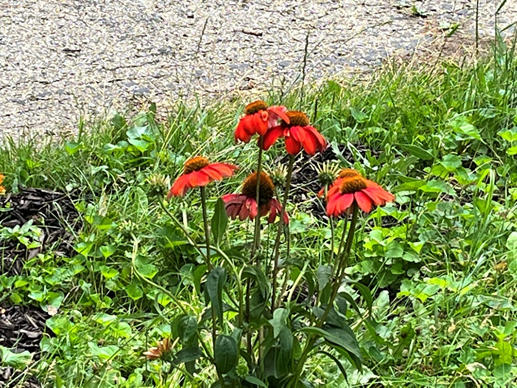
Most of you will notice the issue right away. Remember, this was the beginning of the Project still. I had not dealt with the grass.
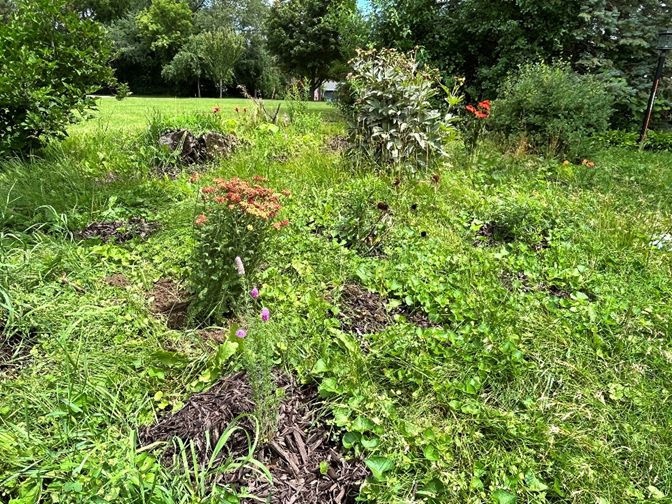
Still, in the summer, it looked awesome! Not like a perennial garden per se, but it was a buzz with pollinator action.
I also added two rather striking, Rattlesnake Masters were added as well.
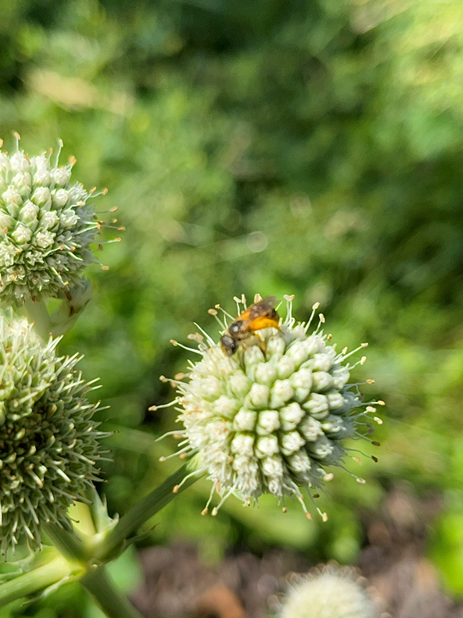
So, how was I going to right this wrong? I should have admitted defeat immediately. I should have covered the grass between my perennial plants with cardboard and mulch and killed the turfgrass. I didn’t; instead, I had hip replacement surgery followed by a tendon transfer surgery on my right shoulder that failed and needed to be replaced that winter. Still, the Butterfly Garden looked beautiful.
So, I hope you have all been paying close attention. You must remove the grass. You should cover it with cardboard, then leaf mulch, and let it sit for longer than you want to. 6-8 weeks.
You will have a clean palette to work with. While you are waiting, you can read some books. You can read some blogs. You can start checking out all the professional gardening websites about planting the appropriate native plants for your region of the country. But only after you have covered that area with cardboard or plastic. You will thank me later.

I, however, have yet to learn my lesson thoroughly. I placed cardboard down to expand the shade garden. I placed cardboard and put mulch down to ready the turf on the east side of the house. Picture and more on these projects to follow.
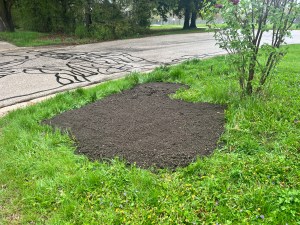
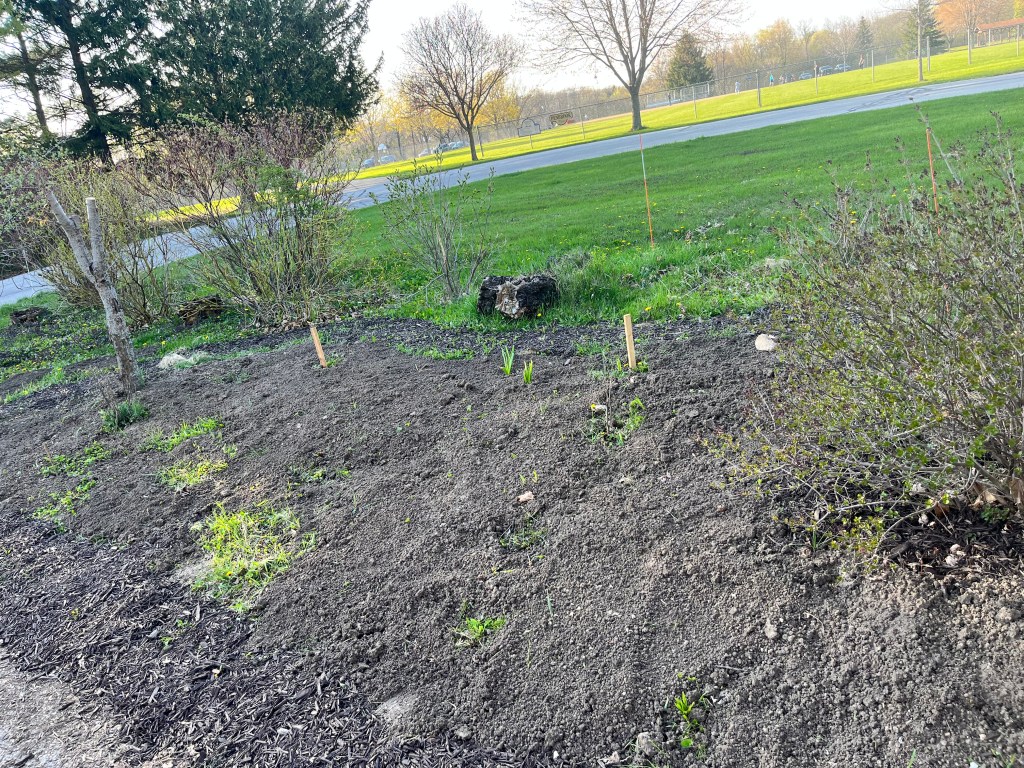
But I have yet to remove the grass in the perennial butterfly garden. I have attempted another shortcut, which I know in my heart of hearts will cause me so much more work in the long run. I mowed the grass around my perennials this spring, then took a bunch of topsoil and one shovel at a time. I am currently unable to lift a wheelbarrow. I have been attempting to bury the grass with soil. This will allow for my winter-hardened seeds to germinate and grow. Seeds I gathered from last year’s flowers and placed in my garage to overwinter.
Fingers crossed. But we both know there will still be a substantial population of grasses and weeds determined to rise through my fertile soil and feel the sun on their blades. I can’t blame them; still, I will attack them viciously with hand and hoe. Wish me luck.
In future articles, we’ll talk more about why lawns suck! And why we can all save the planet one yard at a time. Meanwhile, lay down some cardboard and mulch or plastic on a small section of your yard that receives a goodly amount of sun. And in June we can plant some native perennials. Then join me for more on converting our monoculture desert of a lawn into a biodiverse habitat as we listen for the sounds of summer.
Please hit that like button and tell me how I’m doing. If you have questions, please feel free to write a comment. I will let you know what I find. Lastly, go ahead and share your email in the subscribe area. I will not share or sell any emails. I will use them as a resource to reach my readers. The most recent posts will come directly to your email, and when the book goes up for sale, you will be eligible for a discount.
 T.L. Johnson
Leave a comment