By Terry L Johnson
Potato chips. Is there a more iconic American snack? Here in the US, we consume a lot of potato chips. On average, we chow down on more than 6 pounds of potato chips individually each year. Altogether, those chip bags are filled with some 2 billion pounds of potato chips each year.

A bit of math. Don’t worry; all quizzes are multiple-choice, and you can use a calculator. Also, they’re not graded.
For your Consideration:
It takes four pounds of potatoes to make one pound of potato chips.

4 lbs. potatoes = 1 bag of chips
That’s a lot of spuds. Too big a number for my phone calculator, but fortunately not too difficult for our brains to calculate.
2 billion pounds of potato chips x 4 = Eight Billion pounds of potatoes grown and processed to fill all those chip bags.
8,000,000,000 lbs. of potatoes are used in making potato chips in the United States. Overall, the US grows forty billion pounds of potatoes each year. 20% of all potatoes end up as chips.
All remarkably interesting, you say, but what is your point? We’ve been patiently reading your first blog post, and we still don’t know exactly why. Though we find it both informative and entertaining. (I know, self-aggrandizing, but that’s my go-to) The point of this food blog is not to provide recipes for your nightly supper but to provide insight into the consequences of our choices in the food you and I consume. While biologically, food is more than the energy to fuel your mind and body. It also builds the muscles of your body and the neurons of your developing brain. As well as cushioning our posteriors and enlarging our bellies with unwanted amounts of fats.
That is a lot of potatoes and a lot of chips. These numbers fuel the international market for potato chips, which reached 32.1 billion dollars in 2021.
Each week, this blog will provide simple yet thought-provoking information concerning specific everyday items. We will start with the ingredients as harvested and consider their nutritional value with the goal of comparing the nutrition and environmental impact as they are processed into the finished product. During the week, you can tune in to find more content that will add depth to our conversation and sprinkle in interesting nuggets of knowledge. As well as explore readers’ questions and opinions.
I started with potatoes because they are a major component of my stress-eating go-to snack. (Not sure of the science behind that, it sounds like a good blog topic to me) More specifically, chips and dip. And by dip, I mean sour cream. Pardon the pun, but we will double dip this week and include sour cream’s nutrient content and processing as a bonus at the end of this week’s blog.

Potato Nutrition from Start.
Potatoes are Fat-free, Gluten-free, and an affordable source of carbohydrates. (Energy) They are cholesterol-free and salt-free. They are an excellent source of vitamin C and a good source of vitamin B6 and potassium. A bit of iron and calcium in there as well. 9% of your daily requirement of carbohydrates and 7% for fiber. All for about 110 calories (about 9 minutes of running) per serving. That is uncooked 148 grams.
Start to Finish – Potato to Potato Chip
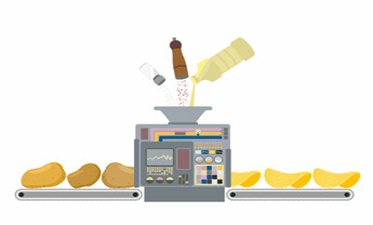
What is done to a potato to make a potato chip? Washed, Peeled, cut, and fried. Some styles or recipes call for the addition of cornstarch to the process. And then there’s the salt. The secret to an addictive processed snack is salt. Some chips contain preservatives as well.
Potato Chip Nutrition to Finish
13% of your daily value of fat. 7% due to saturated fats. (Saturated fats are the bad fats)
They are cholesterol-free but loaded with salt, 7% in a single serving. They are a good source of vitamin C down from 30% unprocessed to 6% in the finished product. All the vitamin D, B6, and calcium have disappeared. Half as much iron and potassium remain as well. The amount of fiber is reduced to 5%. All for around 160 calories (about 13 minutes of running) per serving. That is 28 grams of chips or about 15 individual potato chips.
Start Potato Finish Potato Chip
| Nutritional contribution | % Daily Value | Nutritional contribution | % Daily Value |
| Fat-free | 0 | Fat | 13% |
| cholesterol-free | 0 | cholesterol-free | 0 |
| salt-free | 0 | Salt | 7% |
| vitamin C | 30% | vitamin C | 6% |
| vitamin B6 | 20% | vitamin B6 | 0 |
| potassium | 15% | potassium | 6% |
| Iron | 6% | Iron | 2% |
| Calcium | 2% | Calcium | 0 |
| Fiber | 7% | Fiber | 5% |
| Carbohydrates | 9% | Carbohydrates | 6% |
Numbers appearing in Bold indicate a decrease in desirable qualities.
I don’t know about you guys, but I usually don’t count the chips as they go crunch, but I am pretty sure I consume many more than a serving in one sitting. At the pace indicated by serving size, my bag of chips would take me over two weeks to finish. A single serving taken from a 1 lb. bag once a day. Notice the intent is not for us to consume them slowly. The bags do not come in resealable packaging. And the salt makes us want more. (More on this in a future post)
The FDA and I suspect the manufacturers make comparing the nutritional value of different or similar food products complicated. Do you think this is purposeful?
Take the difference in serving sizes as an example. It does not help that no uniform and scalable measurement is used to determine or inform the serving size. It is a standard industry-wide practice to use different units to measure serving sizes even within the same industry. More on this later this week. Then there’s the fact that serving sizes themselves seem woefully unrelated to reality and mostly illusionary measurements.
The FDA rule is vague “Reference amounts customarily consumed.” So, some studies designed and implemented by the potato chip industry (when I find the source, I will share it with you) showed that the average number of chips consumed by the consumer, you and I, was 15 potato chips. This is 1 oz or 28 grams. 15 was determined to be the average number of potato chips consumed in one sitting. Hmm, I am highly skeptical concerning the accuracy of this measurement. Though it simply might be my personal bias coming into play.
Time to compare what we started with, the potato, to what crosses the finish line after all the processing, the potato chip. How does the potato compare to the potato chip when looking at calories? How can we properly compare a potato, with its 110 calories per serving and serving size of 145 grams, to potato chips, with a serving size of 160 calories but only 28 grams?
The ratio of calories to mass:
.76 calories per gram for potatoes compared to
5.7 calories per gram for potato chips.
So, eating a potato is 110 calories. Eating potato chips, 160 calories if you limit yourself to 15 chips.
You may have noticed in the above calculation that I used grams to measure mass. If you read the About me section on the blog’s main landing page, you will know I am guilty of being an ex-science teacher. As such, I am most comfortable working with the metric system. My wife pointed out that, like her, most of my readers may be less familiar with those units. Therefore, I will provide both.
In English:
The ratio of calories to mass:
20 calories per oz of potato compared to
160 calories per oz for potato chips.
Still eating a potato = 110 calories. A serving size is 5.3 oz.
Eating potato chips = 160 calories. A serving size of 1 oz. If you can limit yourself to 15 chips.
What is the environmental impact of going from potato to chip?
An important and more profound question that we seldom consider is the environmental impact of our food choices. The energy needed to produce the potato chips, from processing the potato to packaging the bag of chips, takes energy and additional resources.
My research determined the amount of energy needed to produce a bag of chips was, well… Big. The exact numbers are hard to come by. A New York Times article reports that one potato chip factory needed 2.6 million cubic feet of natural gas to run its facility. Now that is just the natural gas requirement. It is unclear if that number represents the total cost of energy needed. These large industrial plants also use massive amounts of electricity.
As well as other components, such as compressed air, are used during the chips’ production. Nitrogen gas is also used; it replaces the air in the bag of chips to help them stay crispy.
Then there are the bags that carry the chips to your local grocer or convenience store.
2 billion plastic bags are used to provide us with all those chips. These, of course, are made of plastic, a specific kind called oriented polypropylene. Similar to the plastic used in grocery store bags. This one usually has an aluminum lining placed on the inside. This keeps the nitrogen gas in place, which serves to help keep the chips intact and prevent the fats in the chips from oxidizing. Which I am sure makes it difficult to recycle.
Oh, yeah, and about 50 gallons of water per bag. Reminder a bag is a pound of chips. Thus, our 2 billion pounds of potato chips require a whopping 100 billion gallons of water to process into our chips.
And what about the oil, you may ask? What kind is used for frying up those chips? How much is used? What happens when we heat the oil? What of the leftover oil? What happens to it when it is recycled and reused to produce more chips. Do we have to worry about the oil being reheated time and time again? Is it problematic that it eventually ends up absorbed into the potato chips themselves and finally absorbed into our body’s fat cells? All fantastic questions we will spend time discussing later this week.
Okay, so that was a bunch of information and a lot of numbers. The overall message is crystal clear. It pays to think about what we put in our bodies. It pays to consider where our food comes from. And it is not only healthier for us to be thoughtful consumers, but it is better for the entire planet.
By the way, Sour Cream: Bonus info.
They take light cream, a milk product containing 18-30% cream, and add streptococcus lactis, a bacterium. Then they incubate until the desired flavor and thickness are produced. The bacteria produce lactic acid, and behold, you have Sour Cream! (Acids our sour tasting. Think citric acid, which is found in orange juice.)

Start Nutrients: 1 Tbsp
29 Cal, 4% of daily fats, 3% cholesterol, 3 % vitamin A, and 1% calcium.
Finish Nutrients. 1 Tbsp
24 Cal, 4% of daily fats, 2% cholesterol, 1 % vitamin A, and 1% calcium.
| Nutritional contribution | % Daily Value | Nutritional contribution | % Daily Value |
| Fat | 4% | Fat | 4% |
| cholesterol | 3% | cholesterol | 2% |
| Vitamin A | 3% | Vitamin A | 1% |
| Calcium | 1% | Calcium | 1% |
Overall, not much of a change. Not very healthy to begin with. 24 empty calories per Tbsp. And, of course, processing takes energy and resources such as water. All those plastic tubs. And, well, not a great snack choice.
The conclusion? Eat the potato. Potatoes produce high food energy with a low water use ratio and are efficient crops when the amount of production per acre is considered.
It is easy to grow. It is the most commonly consumed vegetable in the US. We, on average, consume around 50 pounds of potatoes per person annually. The potato is delicious, versatile, easy to prepare, and a good source of fiber and vitamin A. In addition, they contain antioxidants that help prevent disease. To increase nutritional content, keep the skin on and choose colorful potato options. Consider limiting the high-fat toppings such as sour cream and going with lower-fat options such as chili or Salsa.
I hope you find the information provided on this site interesting, engaging, and, well… thoughtful. I look forward to reading your comments and bringing you more on this subject each week.
To subscribe, hit that button. Who knows, you may be the first. Please keep your comments on topic and be nice. I mean, why not.
Thanks for tuning in. Until next time, stay curious.
 T.L. Johnson
Looking good! Thanks for all the food for thought 🙂
LikeLiked by 1 person